

The first line — running from Chintadripet (also known as Chinna Thari Pettai) to Little Mount — was laid in 1835 and opened in 1837 under the name the Red Hills Railway. Its route began at Red Hills, in the northern part of Madras (now Chennai), and ran to the quarries at Little Mount along the banks of the Adyar River. Steam-hauled and approximately three miles (about 5 km) in length, the line was built to carry granite.
In 1845, the Madras Railway company was incorporated, and construction of temporary lines got underway. These included a railway at Dowleswaram, built by Arthur Cotton in 1845 to supply stone for a dam on the Godavari River, and a railway at Roorkee, constructed by Proby Cautley in 1851 to carry building materials to the new Solani Aqueduct.

Sustained railway construction in India, however, only took off following the appointment in 1847 of a new Governor-General: James Andrew Broun-Ramsay, better known as Lord Dalhousie (1812–1860). Before his posting to India, he had served as President of the Board of Trade and played a decisive role in making Great Britain the first country in Europe to be covered by a dense railway network.
On 1 August 1849, the Great Indian Peninsular Railway Company (GIPR) was incorporated under a guarantee system that provided free land and guaranteed a five per cent return to private British companies willing to invest in construction. The GIPR was headquartered in London.

It was the GIPR that, in 1853, built the first passenger railway line in India — a 34 km route between Bombay (now Mumbai) and Thane. Three locomotives — Sahib, Sindh, and Sultan — pulled fourteen-carriage trains carrying around 400 passengers each. Lord Dalhousie personally set the gauge at 5 ft 6 in (1,676 mm). From that point on, this gauge became known as "Indian gauge", though it had in fact first been used in Scotland on two small railway lines — Lord Dalhousie himself being Scottish.
In May 1854, the Mumbai–Thane line was extended to Kalyan via the celebrated viaducts across Thane Creek.

Railway viaduct near Thana, 1855–1862. (Source: Wikimedia Commons. Photo: William Johnson)
In eastern India, the first passenger train ran over the 39 km line from Howrah (a suburb of Calcutta) to Hooghly on 15 August 1854. Construction of a 97 km line in the south — between Royapuram in Madras and Arcot — began in 1853, and the line entered service on 1 July 1856. That same period also saw the establishment of the first railway workshops in India: the GIPR's works at Byculla in 1854 and the Madras Railway's works at Perambur in 1856. Also, during the Governor-Generalship of Lord Dalhousie (who retired and left India in 1856), the Bombay, Baroda and Central India Railway (BB&CI) was founded in 1855.

Logo of the Bombay, Baroda and Central India Railway (Source: Wikimedia Commons)
Subsequently, the Eastern Bengal Railway was established in 1858, followed by the Carnatic Railway in 1869, which in 1874 merged with the Great Southern of India Railway to form the South Indian Railway. It was at this stage that a unified railway network took shape in British India.
The high cost and slow pace of railway construction in the mid-1860s convinced the Viceroy of India at the time, Sir John Lawrence (1811–1879), that metre gauge offered considerable advantages over broad gauge. Moreover, the only way to address the shortage of share capital was through direct government participation. In the early 1870s, this gave rise to the concept of "State Railways" — designed and built with government involvement, owned by the state, but operated by private companies.
On 18 August 1876, the Rajputana State Railway opened, running on 1,000 mm gauge from Delhi to Ajmer, and onward to Indore and Ahmedabad. From this point, the metre-gauge network began to develop rapidly in India as an alternative to the 1,676 mm gauge.

Locomotive F-1/734 at the National Railway Museum, New Delhi, 16 April 2015 (Source: railgallery.ru Photo: Dmitry Shchukin)
The establishment of India's own locomotive manufacturing industry marked a significant milestone. In 1877, the first India-built locomotive — steam engine F-1/734, designed for 1,000 mm gauge — was assembled at Ajmer from British components. By 1895, the same works had produced a locomotive of the same class built entirely from components manufactured in India.
In 1879, the Nizam's Guaranteed State Railway was incorporated and built lines throughout the then princely state of Hyderabad ("Nizam" being the title of the ruler of this vassal state). In 1890, the East Coast State Railway was established. Then in 1908, the Madras Railway merged with the Southern Mahratta Railway to form the Madras and Southern Mahratta Railway.
By 1900, the total length of railways in British India had reached 39,800 km, and they were technically well-developed by the standards of the time. On 24 February 1914, a unique feat of engineering was inaugurated — the Pamban Bridge, spanning the Palk Strait between the mainland and Rameswaram Island, over 2 km long. The bridge remained in service for over a century until December 2022, when services were suspended due to corrosion of the load-bearing structures.

Pamban Bridge, 30 December 2016 (Source: Wikimedia Commons Photo: Shaswat Nimesh)
In 1897, the Jodhpur State Railway became the first railway in India to introduce electric lighting in passenger carriages, and in 1920 electric lamps were fitted to semaphore signals throughout the Bombay suburban area. Technical progress continued apace: in 1928, the section between Bombay and Byculla was equipped with automatic block signalling. Consolidation of railways also continued in the interests of efficiency — in 1924, the Oudh and Rohilkhand Railway was amalgamated with the East Indian Railway Company.
Meanwhile, on 3 February 1925, the first electric train ran between Victoria Terminus in Bombay and Kurla, on a suburban section electrified at 1,500 V DC. On 1 June 1930, the GIPR inaugurated the Deccan Queen — India's first premium express service on the Bombay–Pune route (the Deccan being the plateau of central India).
Electric locomotives of class WCP-1 (EA/1) were procured through competitive tender from the Swiss Locomotive and Machine Works (SLM). Electric locomotive EA/1 No. 4006 was subsequently named after Sir Lawrence Roger Lumley, Governor of Bombay from 1937 to 1943, and is the sole surviving member of a class that remained in service until the early 1980s.

Electric locomotive EA/1 No. 4006, built 1930, at the National Railway Museum, New Delhi, 29 November 2009 (Source: Wikimedia Commons)
Electrification also extended to the metre-gauge network. On 2 April 1931, electric rail services opened in Madras between Madras Beach and Tambaram, operated by 25 electric multiple units supplied from England. The service was inaugurated by Sir George Frederick Stanley, then Governor of Madras, who declared at the opening ceremony that the new railway would transform "the barren southern Madras into a flourishing garden city".
In 1926, the British government classified the railways of India into three categories — a system that bore a notable resemblance to the classification used in the United States:
-Class I railways with a gross annual income exceeding 5 million Indian rupees (Rs);
-Class II railways with a gross annual income of Rs 1–5 million;
-Class III railways with a gross annual income of less than Rs 1 million.

Tramways and non-public railways were accounted for separately, regardless of turnover. In terms of net revenue, the largest company in 1927 was the East Indian Railway, with earnings of Rs 86,881 thousand, Rs. followed by the North Western State Railway with Rs 57,343 thousand and the GIPR with Rs 56,215 thousand. Rs. No reclassification was carried out after 1942, and in 1944, under wartime conditions, all railway companies were transferred to government control. The classification system nonetheless continued to be used in independent India until the late 1950s.
To conclude the survey of the colonial period in the development of the Indian railway network, it should be noted that it was never simply a replica of the British railway system and always retained a distinct identity — technically, economically, and organisationally.

On 15 August 1947, India declared independence (the Dominion of Pakistan having been separated from it a day earlier). At the time of Partition, the country had 59,400 km of railways and 42 railway companies.
On 26 January 1950, India became a republic. That same year, the overwhelming majority of the network was nationalised, and the Central Advisory Committee on Railways endorsed a reorganisation plan. In 1951–1952, the Southern, Central, Western, Northern, Eastern, and North Eastern Railways were formed In 1955, the South Eastern Railway was carved out of the Eastern Railway, and the following year a divisional structure was introduced across the railway system. In 1958, the North Eastern Railway was split, with the North East Frontier Railway being established as a separate zone The state-owned Indian Railways (IR) network — with an operational length of 54,959 km as of 31 March 1955 — incorporated all broad-gauge and metre-gauge railways, as well as a portion of the 762 mm and 610 mm gauge lines.
A small proportion of the network (890 km) remained in private hands, comprising solely 762 mm and 610 mm gauge lines.

Alongside the institutional reforms on the railways, the transport engineering industry was developing rapidly.
On 26 January 1950 — the very day India was proclaimed a republic — the first stage of the steam locomotive manufacturing plant at Chittaranjan was commissioned, and in 1954 the North British Locomotive Company produced India's first diesel locomotive.

In contrast to the colonial era, greater attention was paid after independence to the needs of ordinary passengers. In 1952, fans and lighting were installed throughout all passenger compartments and sleeping berths were introduced. By 1956, the first air-conditioned train was already running between Howrah and New Delhi. Passenger carriages based on a Swiss prototype were being produced in India from 1955, when the Integral Coach Factory (ICF) was established at Perambur, a suburb of Madras.
New lines continued to be built under the Five-Year Plans, on both broad and metre gauge. In 1955–1956 alone, the following sections were opened: Gop–Katkola and Gandhidham–New Kandla (1,000 mm gauge, 45 km in total), and Pathankot–Madhopur, Sini–Gomaharri, Anara–Garh-Dhrubeshwar, Joychondipahaar–Ramknali, and Uttaraithia–Dilkusha (1,676 mm gauge, 48 km in total).
In 1957, the decision was taken to introduce 25 kV AC electrification on IR. Trial runs of WAM1-class locomotives, built by a European consortium, were conducted in 1959, with regular operations commencing in August 1960. In 1966, AC electrification was extended to a number of broad-gauge suburban lines in Delhi, Madras, and Calcutta.

Electric locomotive WAM1 No. 20202, 30 March 2004 (Source: Wikimedia Commons). Photo: Shamim Mohamed)
The 1960s marked the period in which the foundations for high-speed rail in India were laid. In 1960, India's Ministry of Railways commissioned a study into raising passenger train speeds to 160 km/h, with an intermediate target of 120 km/h. Work on the project began in 1962, and in 1967 field trials of new ICF-built coaches under diesel traction commenced. As a result, in March 1969 the Rajdhani Express — capable of reaching 120 km/h — was launched between New Delhi and Howrah. Those same years also saw India's first containerised rail freight services, launched in 1966 between Bombay and Ahmedabad.
By 1971, the operational length of India's railways had grown to 59,790 km — an increase of more than 6% over the decade. At the same time, urban transport infrastructure was becoming increasingly strained, making it necessary to introduce a new form of rail transport to India: metro rail to complement suburban railways and trams.

Plans to build a metro in Calcutta had first been announced as early as 1949 by the Governor of West Bengal, but actual work only began in 1971, following a visit by specialists from Lenmetroproject, who had drawn up a feasibility study for the city of 10 million. In December 1972, Prime Minister Indira Gandhi approved the construction decision, and work began the following year with the involvement of Soviet and East German engineers. The first section of the Calcutta Metro opened on 24 October 1984.
Notably, despite being built to 1,676 mm gauge, the metro was in many technical respects closely modelled on the Leningrad Metro, including the signalling, interlocking, and automatic train operation systems adopted as reference models.

Inspection tour of the Calcutta Metro under construction (Source: Somen Sengupta. Four decades of Calcutta Metro: The unstoppable journey // The Statesman. 27 October 2024.)
In the 1980s, IR kept pace with the times by embarking on the computerisation of the industry. In 1986, the first computerised ticketing and seat reservation system was introduced. Four years later, Delhi saw the installation of the first Self-Printing Ticket Machine (SPTM). The Indian Railways website went live in February 2000, and from 3 August 2002 tickets became available for purchase online.
In 1992, India embarked on a programme of gauge unification. The conversion of 1,000 mm gauge lines to 1,676 mm is now approaching completion. Broad-gauge lines currently account for more than 96% of the total network length, which stood at 68,584 km at the end of 2023.

Steady progress has also been made on high-speed operations. In 1988, the Shatabdi Express was launched between New Delhi and Jhansi. On 5 April 2016, the Gatimaan Express made its inaugural run from New Delhi to Agra at a maximum speed of 160 km/h, making it the fastest train in India at the time. India's current fastest train is the Vande Bharat Express, an electric multiple unit introduced in 2019 and built by ICF, which achieved 183 km/h during trials (with a maximum operational speed of 160 km/h). Nevertheless, many railway lines are already authorised for speeds of up to 200 km/h.
Beyond high-speed services, a number of other significant trends emerged in IR's development during the 2010s. Electrification of lines on AC is proceeding actively, as is the conversion of sections previously electrified on DC to AC. The Western Railway completed its full transition to AC in 2012, followed by the Central Railway in 2016.
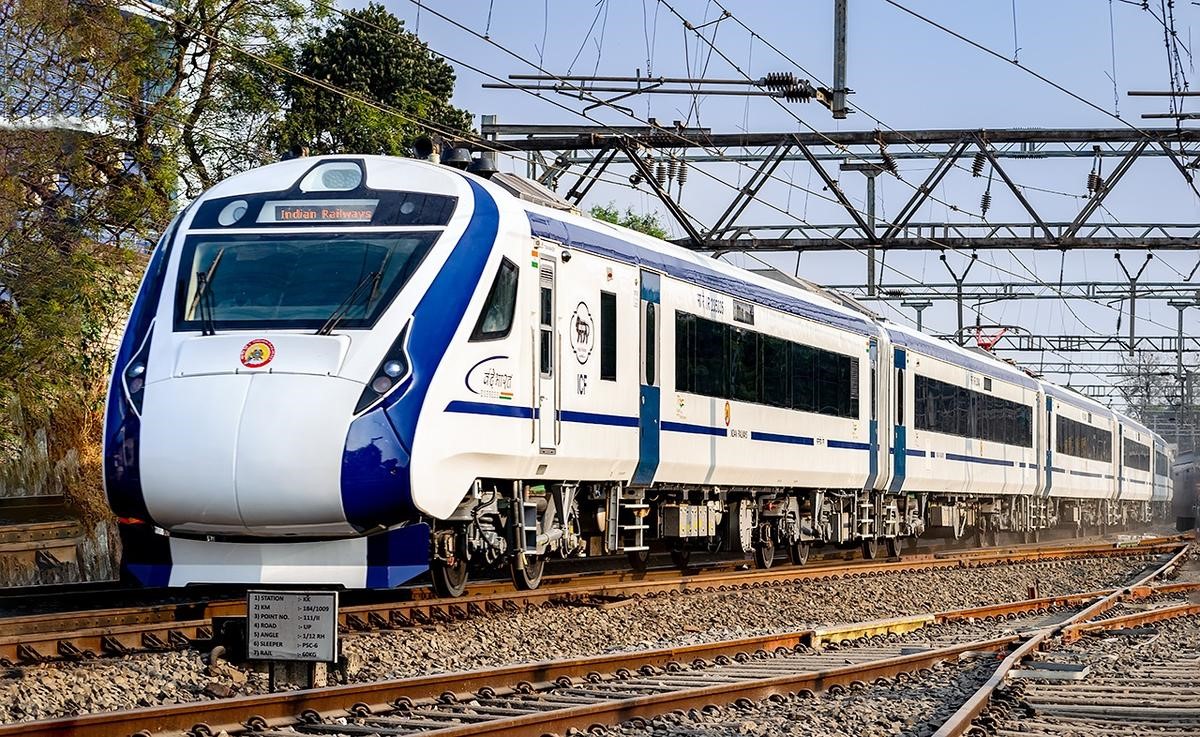
Vande Bharat Express near Mumbai, 25 February 2023 (Source: Wikimedia Commons)
Under the Indian railway development plan published in 2022, all passenger services are expected to be converted to electric traction by the end of 2026. By the end of 2024, electrified lines are projected to account for 96.6% of the total network length. A number of Indian manufacturers have already discontinued production of diesel locomotives for the domestic market, retaining only export-oriented output. The
2010s also brought a significant expansion of the network: the operational length increased by 6% over the period — comparable to the growth recorded in the 1960s — alongside extensive station reconstruction and the construction of second tracks. Safety has received considerable attention as well, with the construction of grade-separated crossings and the closure of unmanned level crossings (all of which had been eliminated by 2019).

The legal framework governing the sector also underwent important changes. India's railways had maintained a separate annual budget since 1924; however, on 21 September 2016, the landmark decision was taken to merge the railway and Union budgets with effect from 2017. In 2020, IR's monopoly on passenger services was broken for the first time, with private passenger trains permitted to operate — the first such service departed from Coimbatore in June 2022.
India currently intends to build its first high-speed railway, with speeds of 250 km/h, between Mumbai and Ahmedabad. The government has tasked ICF with producing two ultra-high-speed trainsets by spring 2025. Design and construction of a depot for high-speed rolling stock in Thane have already been scheduled. The project will draw on the experience of Japan's Shinkansen high-speed rail lines.

"Today I give the nation a guarantee that in the next five years, Indian railways will see a transformation that no one could have imagined," pledged India's Prime Minister Narendra Modi in June 2024.
India
o Area: 3.3 million km²
o Railway network length as of early 2023: 68,100 km
o Electrified railway lines: 44,800 km
Prospective transport projects in India
Construction of a high-speed road network totalling 50,000 km. Investment: USD 100 billion.
- Construction of the Delhi–Ahmedabad high-speed corridor, 900 km.
- Construction of the Mumbai–Ahmedabad high-speed railway, 500 km Investment: USD 20 billion.
- Construction of the Delhi–Amritsar high-speed railway, 500 km. Investment: USD 6.2 billion.
- Construction of the Mumbai–Chennai high-speed railway, 1,400 km. Investment: USD 17 billion.
A joint project of 1520International and the Institute for Economics and Transport Development (IETD)
 Read next content