

We are continuing our series of publications in the "Historical Chronicles" section — on the history of the establishment and development of railways in the BRICS countries. This latest issue covers the development of railway transport in Iran.
The first railway in Persia (the former name of Iran) was built under a concession granted to the "Anonymous Society of Railways and Tramways" from Belgium in 1888, running between Tehran and the mausoleum of Shah Abdul-Azim in Rey. This was during the reign of the reformist ruler Naser ad-Din Shah Qajar, who sought to introduce Persia to European civilization.
The line was a narrow-gauge railway measuring 9 km in length, with a track gauge of 800 mm. The opening of the railway sparked protests among competitors — the owners of caravans that transported pilgrims to Rey — and in 1890, an attempt was even made to set fire to a train. However, the narrow-gauge line continued to operate and was closed only in 1952. Today, Line No. 1 of the Tehran Metro runs along its former route.

Railway from Tehran to the Mausoleum of Shah Abdul-Azim, late 19th century (Photo: Anton Sevrugin. Colorization: BSPchannel)
With the accession to the Persian throne in 1907 of Mohammad Ali Shah, who was sympathetic to Russia, relations between the country and the Russian Empire notably strengthened. Among other developments, an agreement was reached to construct a railway from Jolfa, on the Persian-Russian border, to the city of Tabriz. In 1908, the "Society of the Tabriz Railway" was established. The 148 km line, with a gauge of 1,524 mm, was built with the participation of Russian engineers under difficult conditions — the surveys took place during the Persian civil war of 1908–1909, which ended with the overthrow of Mohammad Ali Shah, and construction was only completed during World War I (temporary operation began in 1915, and permanent operation commenced in 1916, when the branch line from Sofian to Sharafkhaneh to Lake Urmia was opened).
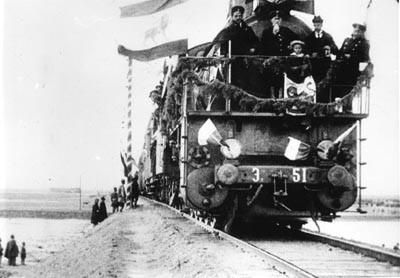
Arrival of the first train in Tabriz, January 1914 (Still from the film by the Skobelev Committee, "Opening of the Tabriz Railway." The film is held in the Russian State Archive of Newsreels and Documentary Films)
On 26 February 1921, according to the "Treaty of Friendship" between the RSFSR and Persia, the railway section from the state border to Tabriz was transferred free of charge by the Bolsheviks to the full and exclusive ownership of the Iranian people. It was operated jointly by the USSR and Persia (which from 1935 bore the official name "Iran") until 1942, when the Soviet government deemed further participation in the project inexpedient.
The next railway was built by the British in 1920–1921, during the period of de facto British occupation of the country, between the cities of Zahedan and Mirjaveh, with a connection to the British Indian railway network. The line measured 94 km in length, and continues to use "Indian gauge" — that is, 1,676 mm — to this day.
Thus, by the mid-1920s, Persia had three separate railway sections of different gauges that were not connected to one another. However, in 1925, Parliament adopted a railway development plan. Its principal objective was to connect the shore of the Caspian Sea to the Persian Gulf via a main railway line.

Photo: 123RF/Legion-Media
Construction of the Trans-Iranian Railway (gauge 1,435 mm) measuring 1,392 km, running from Bandar Shah (now Bandar Turkmen) on the Caspian Sea through Tehran to Bandar Shahpur (Bandar Khomeini) on the Persian Gulf, took place between 1927 and 1938. The work was initially undertaken as a joint American-German enterprise, then by German companies alone, and from April 1933 onwards by the Danish firm "Kampsax," which engaged numerous subcontractors. The American withdrawal from the project in 1930 was preceded by a train accident during which Shah Reza Pahlavi was personally inspecting the construction. Due to the railway embankment being washed away by heavy rains, the shah found himself stranded for two weeks in the city of Ahvaz, where he was forced to wait for the torrential rains to cease. Following this, the Iranian government suspended payments to the Americans.

Photo: 123RF/Legion-Media
The Trans-Iranian Railway was constructed using rails weighing 67 pounds per yard (33 kg/m). It features approximately 230 tunnels and 4,100 bridges and culverts, employs railway spirals to overcome steep elevation changes, and its highest point is located in Erak at an elevation of 2,220 m above sea level. The construction of the railway cost Iran 2,195,180,700 rials, financed largely through taxes on sugar and tea, the production of which was monopolized by the Ministry of Industry as part of Shah Reza Pahlavi's economic reforms.
During World War II, in August 1941, Soviet and British Allied forces entered Iran to ensure the security of supplies of military equipment, strategic raw materials, and other cargo destined for the USSR (Operation Agreement). In September, the Allies took control of the operation and maintenance of the Trans-Iranian Railway: the British Royal Engineers Corps took control of the southern section between Tehran and Bandar Shahpur (in December 1942 they transferred control to the U.S. Transportation Corps), while the Red Army assumed control of the northern segment of the line between Tehran and Bandar Shah.
To increase the capacity of the Trans-Iranian route, the British also constructed during these same years a 75-mile (121 km) branch railway from the city of Ahvaz to the new port at Khorramshehr on the Shatt al-Arab River. In 1943, diesel-electric locomotives first came to the aid of steam locomotives on the American section of the Trans-Iranian Railway (a total of 75 ALCO RSD-1 diesel locomotives were in service).

American train on the Trans-Iranian Railway carrying cargo for the USSR, 1943 (Source: Wikimedia Commons. Photo: Nick Parrino)
With the U.S. Lend-Lease program concluding in May 1945, American forces withdrew their diesel locomotives in June and handed the Trans-Iranian Railway back to British administration, which subsequently passed operational control to Iran's state railways.
After World War II, railway construction in Iran continued. By the end of the 1950s, two major railway lines that had been started before the war were completed. First, there was a main line measuring 812 km, connecting Garmsar station on the Trans-Iranian Railway with Mashhad — the sacred city of Shia Muslims, visited annually by millions of pilgrims. Second, there was the Tehran–Tabriz line, 736 km in length, which gave Iran's railway network access to the railways of the Soviet Union via the Tabriz–Jolfa section, which had by then been regauged to 1,435 mm.

Photo: АR/TASS
However, the longest project to implement was the construction of the Qom–Zarand Railway, measuring 847 km with a branch from Sistan to Zarrinshahr (111 km), which began in 1939 and was fully completed in 1971. This line provided railway transport to the central regions of Iran, including Isfahan — the country's third-largest city after Tehran and Mashhad — which is home to a steel mill built with Soviet assistance. Also by 1971, the extension of the Sofian–Sharafkhaneh branch to Razi station on the Turkish border was completed.
The last significant railway construction project in monarchical Iran was an 80 km extension of the Qom–Zarand main line to the city of Kerman. The events of the 1979 Islamic Revolution and the Iran–Iraq War of 1980–1988 seriously slowed the implementation of infrastructure projects. A notable exception was the completion in 1982 of the electrification of the Tabriz–Jolfa railway section at 25 kV AC, carried out with the assistance of Soviet specialists under a contract concluded as early as 1975.

Railway station in the city of Mashhad (Source: Wikimedia Commons. Photo: Parthsbod K.A. Hakhamaneshian)
However, in 1990, the first five-year plan for the socio-economic development of the Islamic Republic of Iran was adopted. The development of railway transport — including the construction of new railways and the modernization of existing lines — was named as one of the priority areas. The country effectively entered a railway boom.
A landmark achievement came in 1995 with completion of the 626-km Bafq–Bandar Abbas line, establishing a vital connection to the crucial Hormuz strait port.. This was followed in 1997 by the western section of the Tehran bypass Aprin–Maleki (24 km) and the line connecting Iran with Turkmenistan as part of the New Silk Road, Mashhad (Feridon)–Sarakhs, measuring 165 km; and the following year, the Badrud–Meybod section (254 km), which straightened the Qom–Kerman main line. In 1999, the section Islam-Shahr (Aprin)–Mohammadieh, measuring 129 km to relieve congestion on the Trans-Iranian main line, was constructed, as was the Chadormaloo–Erdjaneh branch (226 km) to develop the Chadormaloo iron ore deposit. For the efficient operation of the network, sorting yards at Aprin and Mohammadieh were built, as were 290 km of second tracks.

Train with RC4 electric locomotive of the Iranian Railways at Jolfa-Irani station (Source: Wikimedia Commons. Photo: Ghorbanalibeik)
In the 21st century, the expansion of the railway network continued. In 2001, access to the new sea port of Bandar Amirabad on the Caspian Sea was constructed. The following year, the Qom–Kerman main line was extended by 225 km to Bam station. In the first decade of the 21st century, the final (eastern) section of the Tehran bypass, Aprin–Behram (31 km), was commissioned, as was a 37 km bypass around the city of Ahvaz.
On 3 May 2005, a ceremonial opening of traffic on the new Bafq–Mashhad (Feridon) main line, measuring 790 km, took place in Mashhad, attended by the President of the Islamic Republic of Iran Mohammad Khatami, as well as transport and communications ministers from 12 countries, including Gennady Fadeyev, President of Russian Railways (RZD). The commissioning of this railway shortened the Sarakhs–Bandar Abbas route by almost 900 km, and now the majority of cargo from Central Asian countries is routed to Bandar Abbas port via this railway route. Since 2022, this route has also been used by Russian container trains.

Container train on the Bafq–Bandar Abbas line (Source: rogerfarnworth.com)
Two important projects were completed in 2009. The first was the connection of Shiraz, one of Iran's largest and oldest cities, to the country's railway network via the Isfahan–Shiraz line (506 km). The second was the construction of the Bam–Zahedan section, measuring 320 km, which gave the Indian subcontinent an uninterrupted rail link with Europe and Central Asia via Iranian territory. From this time onwards, the country saw an increase in projects oriented toward international connections.
Thus, in 2011, the 16 km section of the Khorramshehr–Shalamche line (a station on the Iraq border) was put into operation, and in 2023, Iraq began work to extend it to the city of Basra, as a result of which the railway networks of Iran and Iraq will soon be connected. On 3 December 2014, the Gorgan–Inche Borun section with access to Turkmenistan was commissioned — thus, the eastern railway corridor of the North–South International Transport Corridor (ITC) was fully formed. On 29 March 2018, the railway line with a gauge of 1,520 mm between the stations Astara-Iran and Astara-Azerbaijan was officially opened — the key section of the western route of the North–South ITC.
In 2017, construction was completed on the Haf–Shamteg section (border with Afghanistan), which extended the Torbat-e Heydarieh–Haf line, which had been in operation since 2007. Later, the line was extended into Afghanistan — the first train from Iran to Herat arrived on 11 July 2023.
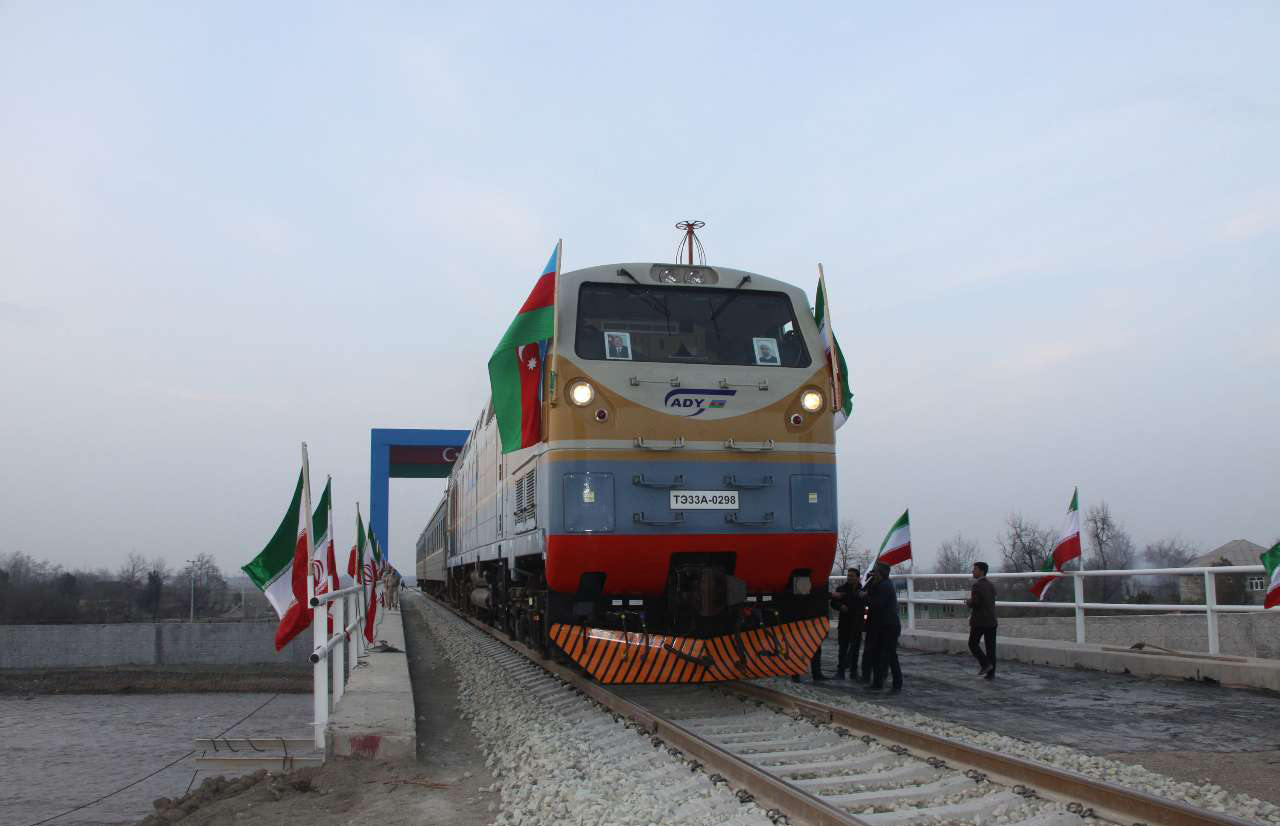
The first train from Astara-Azerbaijan crosses the Iranian border (Source: financialtribune.com)
Meanwhile, domestic infrastructure projects received significant attention. The following railway lines were progressively opened: Erak–Melayer–Kermanshah, measuring 267 km (in 2011 and 2018), and, in the same years, Maragheh–Miandoab–Urmia, measuring 183 km; Aprin–Hamadan–Sanandaj, measuring 420 km (in 2017 and 2023); the Miane–Bostanabad–Tabriz (Havran) shortcut, measuring 176 km (in 2019 and 2023); and Qazvin (Siah-Cheshmeh)–Rasht–Bandar Anzali with a branch to Caspian port (in 2018 and 2024), measuring 194 km. Additionally, the connector line Yazd–Eqlid, measuring 271 km, was constructed and opened in 2021.
Alongside new rail projects, Iran embarked on an ambitious modernization program for its existing network. In addition to the construction of second tracks on the most heavily freight and passenger-congested sections, noteworthy is the electrification of the 46 km Tabriz–Azarshahr railway section with Russian assistance, which was ceremonially opened on 13 October 2012 in the presence of a delegation from Russian Railways (RZD).

Photo: Zuma/TASS
At present, the priority tasks in railway construction in the Islamic Republic of Iran include the construction of the Rasht–Astara-Iran, Zahedan–Chabahar (whose key section Zahedan–Hash, measuring 160 km, was opened in 2022), and Shiraz–Bushehr lines, as well as new connections to the Turkish and Iraqi borders.
High-speed rail projects are also being implemented in Iran. Interestingly, this issue has a long history. As far back as 1975, Iran's transport minister visited Japan to study the country's high-speed railways. As a result, a reciprocal visit by a Japanese railway delegation took place. Following the examination of the Tehran–Mashhad route, the visitors proposed, as one option, the construction of a new dedicated high-speed line designed for speeds of 270 km/h (that is, higher than the speed in Japan at that time — 210 km/h). However, subsequent political events forced the postponement of these plans.

Photo: Zuma/TASS
At present, the priority project is the construction of a high-speed railway measuring 410 km, connecting Tehran, Qom, and Isfahan. Construction began on 25 February 2015. The project consists of two segments: 165 km from Tehran to Qom and 245 km from Qom to Isfahan. It is expected that speeds on the new line will reach 350 km/h, with completion targeted for approximately 2025.
Iran
- Area: 1.6 million km²
- Railway network length as of early 2023: 9,400 km
- Length of electrified railway lines: 200 km
Prospective transport projects in the Islamic Republic of Iran
- Construction of the Rasht–Astara railway line, measuring 200 km. Investment: USD 1.7 billion.
- Construction of the Zahedan–Chabahar railway line, measuring 600 km. Investment: USD 0.8 billion.
- Construction of the Zahedan–Birjand–Yonesī railway line, measuring 800 km. Investment: USD 1.9 billion.
- Construction of the Shalamche–Basra (Iraq) railway line, measuring 30 km. Investment: USD 120 million.
A joint project of 1520International and the Institute for Economics and Transport Development (IETD)
 Read next content