
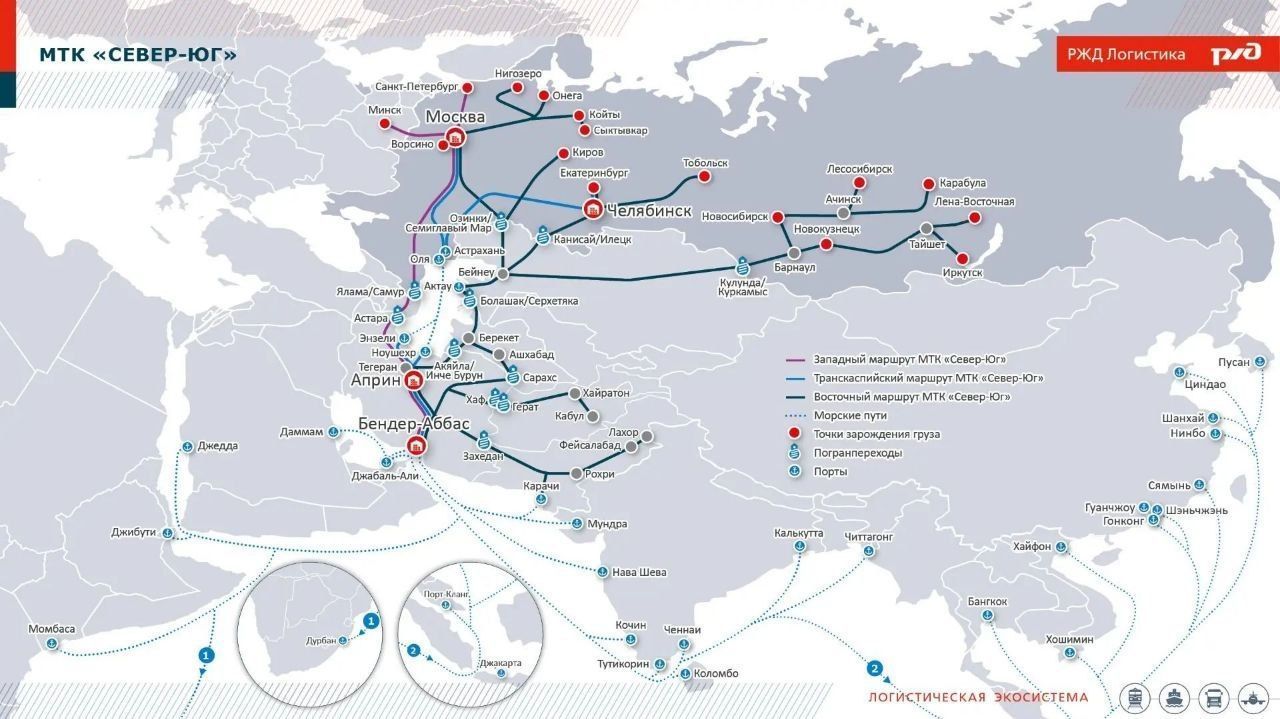
RZD Logistics has moved a consignment of porcelain tile from Iran to Russia along the western branch of the International North–South Transport Corridor (INSTC). Carrying construction materials is one way of tackling the corridor’s backhaul problem.
JSC RZD Logistics has completed a pilot shipment of porcelain tile for one of Iran’s largest manufacturers along the western route of the INSTC, the company’s press service reports. The cargo was dispatched from Astara station on the Iranian–Azerbaijani border and arrived at the Kuntsevo-2 terminal and logistics center in Moscow. The western branch of the INSTC runs through Iran, Azerbaijan and Russia.
The announcement notes that the shipment was multimodal. The shipper itself handled the road leg from the plant to Astara station. From Astara on to Kuntsevo-2, the full package of delivery services was provided by RZD Logistics. “At the Kuntsevo-2 terminal and logistics center the client was offered an additional service package that included a temporary storage warehouse for customs clearance, consolidation of the cargo and its distribution to the end consignee. The transport solution was designed specifically around the client’s requirements,” the press release emphasizes.
“One of our priorities is to press ahead with the intensive development of traffic along the INSTC, including the western branch of that route. We looked closely at what the client needed and at the economics of the various transport options. A multimodal shipment built around the western arm of the corridor proved to be the most balanced alternative. We are convinced this is only a first step, and that the solution has serious potential for further volume growth—all the more so because construction materials are a growing item in Iran’s exports to Russia,” said Oleg Poleev, CEO of JSC RZD Logistics.
The pilot dispatch confirmed that the route works and opened the way for further growth in imports from Iran along the corridor’s western branch. It is one more contribution to solving the INSTC’s backhaul problem. The imbalance of traffic flows—far more freight moves southbound along the corridor than northbound—has long been named by experts among the most serious obstacles to raising volumes. One consequence is that operators are forced to send rolling stock back empty, which drives up costs.
Building up cooperation with Iranian producers of construction materials is one of the key strands of JSC RZD Logistics’ work on securing backhaul cargo for the INSTC. Iran is today among the world’s leading producers of ceramic and porcelain tile, while the Russian market remains one of the priority export destinations for the country’s manufacturers. By various estimates, Iranian products account for between 7 and 9% of the Russian ceramic tile market. Against this background, the launch of new transport solutions could become an additional driver of growth in bilateral trade and strengthen the position of the INSTC’s western route in the construction materials segment, the company says.
Dmitry Koptev
 Read next content