

A passenger train at the old railway station in Taiping, 1885. The building still stands today and houses a shopping center. (Source: ru.pinterest.com)
In 1886 the line was extended to connect the tin-rich district of Larut with the port, which strengthened the region's economy and the entire tin-mining industry — the foundation of the country's economy in the late 19th century.
Five years later, in 1891, the construction of a railway line was completed in the Sultanate of Selangor, between Kuala Lumpur and Klang, linking the sultanate's capital with the nearest port. This line played an important role in facilitating the export of goods, in particular tin and rubber. Interestingly, in those years Malays were rarely to be found among the workers of the local railways: managerial positions were held by the British, while the laborers were predominantly immigrants from India.
Meanwhile, in 1896 the sultanates of Perak, Selangor, Negeri Sembilan, and Pahang united to form the Federated Malay States — a British protectorate with its capital at Kuala Lumpur. As the railway network grew, the need for centralized management became evident. Therefore, in 1910 the Federated Malay States Railways (FMSR) administration was established, uniting the various regional railway systems. This ensured coordinated development, paving the way for the creation of the two trunk lines that would become the backbone of the national network — the West Coast Line and the East Coast Line.

The FMSR headquarters building in Kuala Lumpur. On the left, the railway line running north from Kuala Lumpur; on the right, the goods yard (circa 1910). (Source: Wikimedia Commons. From the photograph collection of Leiden University Library. Photograph: Carl Josef Kleingrothe)
The West Coast Line, completed in 1923, ran from Padang Besar on the border with Siam (Thailand) in the north to the Woodlands railway checkpoint in Singapore in the south. This line connected the major cities of the west coast, including Ipoh, Kuala Lumpur, and Johor Bahru. It became the principal route for freight and passenger traffic, playing a key role in the economic integration of the entire region — including the territories outside the federation, namely Penang, Malacca, and Singapore (directly subordinate to Britain), as well as the formally independent Sultanate of Johor.
The East Coast Line, built by 1931, connected Gemas on the West Coast Line with Tumpat in Kelantan. This line opened up the east coast of the Malay Peninsula, which was economically less developed than the west, providing a reliable means of transporting agricultural produce — in particular rubber and palm oil — to the markets of the west coast and beyond.
In early 1942, Japanese armed forces launched a rapid offensive against the southwestern Pacific and the countries of Southeast Asia, including Malaya.

Japanese troops seizing a railway station in Johor, 1942. (Source: Wikimedia Commons)
During the Second World War, the FMSR was severely damaged. The reason was that in June 1942, in order to establish control over Southeast Asia and block the British counteroffensive into Burma (Myanmar), the Japanese — using the labor of convicts and prisoners of war — began building the notorious Thailand–Burma Railway (the “Death Railway”). To accelerate its construction, a number of railway sections in Malaya were dismantled, and their bridges, rails, and rolling stock were shipped to the Thailand–Burma Railway.
After the war, the British colonial government began gradually restoring Malaya's railway system. In 1946, Britain resolved to reorganize its possessions on the peninsula into the Malayan Union, merging all the dependent sultanates (except Singapore) with the Malay states of Perlis, Kedah, Kelantan, Terengganu, and Johor. However, owing to strong discontent among the local national elites, the British backed down, and in 1948 the Malayan Union was transformed into the Federation of Malaya — an association of autonomous sultanates. That same year, the FMSR was reorganized into Malayan Railways (MR).

The old Kuala Lumpur railway station, built in 1910–1917, architect Arthur B. Hubback. It ranks among the ten most beautiful railway stations in the world. (Source: www.piqsels.com)
The year 1957 was marked both by the Federation of Malaya's attainment of independence and by the start of operation on its railways of the first batch of English-built diesel locomotives (“Class 20”). In addition, the railway infrastructure was modernized: from 1960, electric interlocking of points and signals, as well as semi-automatic block, was introduced. By this time, the length of the restored network on the peninsula had reached its prewar figure of 2,100 km.
In 1963, the Federation of Malaya merged with the former British colonies of Singapore, Sarawak, and North Borneo to form a new federal state — Malaysia (two years later Singapore left the federation) — and the official name of Malayan Railways was changed to the Malay “Keretapi Tanah Melayu” (KTM).
In this connection, it is worth noting that North Borneo and Sarawak, located in the northern part of the island of Borneo, also had railways during the colonial period: by the start of the Second World War their length was 193 and 16 km respectively (meter gauge). During the war they were destroyed, and while the network in North Borneo had been restored by 1960, Sarawak has no railways to this day.

A railway bridge over the Papar River in the Malaysian state of Sabah (former North Borneo), 16 November 2011. (Source: Wikimedia Commons. Photograph: Uwe Aranas)
From the early 1960s, owing to the rapid development of road transport, the railways of Malaysia faced growing competition. Nevertheless, the overwhelming majority of the network on the Malay Peninsula was preserved. The island railway network of former North Borneo (the state of Sabah), however, managed by the company Jabatan Keretapi Negeri Sabah (JKNS), had by 1974 shrunk to a single line, decreasing by almost a third — to 134 km.
To remain competitive, KTM launched several modernization projects.
An important milestone of this period was the introduction, in 1989, of intercity rail services under the KTM Intercity brand. This was a significant event in the history of Malaysia's railways, as it broadened the range of options for long-distance travel. Among KTM's flagship trains were the international night express “Senandung Malam,” linking Kuala Lumpur with the town of Hat Yai in southern Thailand; the “Rakyat” express, running between Johor Bahru and Butterworth; and the “Wau” express, connecting Kuala Lumpur with Tumpat.

A British-built “Class 22” diesel locomotive (1971) at the National Museum of Malaysia, 14 August 2023. A total of 40 such locomotives were built, but their era has now come to an end. (Source: Wikimedia Commons)
One of the key events of this period was the electrification of the railway network in the Klang Valley, which began in 1989 (25 kV AC). This modernization laid the foundation for the development of commuter rail services, which would take on increasing importance in the following decades.
In 1995, KTM launched the first commuter electric-train route in Malaysia under the KTM Komuter brand. Initially, KTM Komuter served the central part of the Klang Valley, consisting of two lines — Batu Caves (north of Kuala Lumpur)–Pulau Sebang and Tanjung Malim–Port Klang — and quickly became an integral part of the region's public transport network and a reliable alternative to the congested roads. And in 2015 the service was extended to the northwestern part of the country, when Butterworth was linked by commuter trains with the towns of Padang Besar and Ipoh.
This had been preceded by the completion, in 2008, of the reconstruction of the West Coast Line between Kuala Lumpur and Ipoh, when a second main track was laid on this 179 km section and electrification was carried out. Two years later, high-speed service was launched on the section (a maximum speed of 160 km/h — an impressive result for meter gauge) under the Electric Train Service (ETS) brand, reducing the journey time between the two cities to 2.5 hours. Later, ETS trains also began running on the Ipoh–Padang Besar and Kuala Lumpur–Keluang sections.

A Class 93/2 high-speed electric train at Kampar station, 12 March 2022. (Source: Wikimedia Commons)
Urban rail transport in the Kuala Lumpur agglomeration also advanced significantly thanks to the introduction of a light rail transit (LRT) system. It initially adopted the 1,435 mm gauge and a 750 V DC electrification system using a contact (third) rail. The Ampang Line (formerly STAR LRT) opened in 1996, followed in 1998 by the Kelana Jaya Line (formerly PUTRA LRT). They are operated as part of the Rapid KL system by Rapid Rail, a subsidiary of Prasarana Malaysia. These lines were a long-awaited solution to the problem of growing traffic congestion in the Klang Valley. In 2016–2023, two more lines were opened in stages within this system, which can already be considered a full-fledged metro, as they run partly underground.
A six-car “AMY” model train, manufactured by the Chinese company CRRC Zhuzhou Locomotive, departs from the Sultan Ismail LRT station in Kuala Lumpur, 13 August 2023. (Source: Wikimedia Commons)
The 1,435 mm gauge was also used on the ERL express line, opened in 2002 between Kuala Lumpur and the city's international airport (KLIA); in this case, however, a 25 kV AC electrification system was employed — as on the narrow gauge. The 38 km journey between the city and the airport is covered in just 28 minutes. And in 2003 a monorail line appeared in Kuala Lumpur; it has 11 stations and carries 20 million passengers a year.
At present, the operating length of Malaysia's railways is 2,050 km. Of this, 1,789 km are 1,000 mm gauge lines (47% double-track and electrified), 252 km are 1,435 mm gauge (including the ERL, the capital's light rail transit, and the metro), and 9 km are monorail.
Malaysia's railway transport continues to develop along several fronts at once.
First, the country's first inter-regional railway with a 1,435 mm gauge is under construction: the East Coast Rail Link (ECRL). Along this 665 km double-track electrified trunk line between Kota Bharu and Port Klang, passenger trains will run at 160 km/h and freight trains at 80 km/h. As of July 2025, the line was 85% complete, with completion of the works scheduled for 1 January 2027.

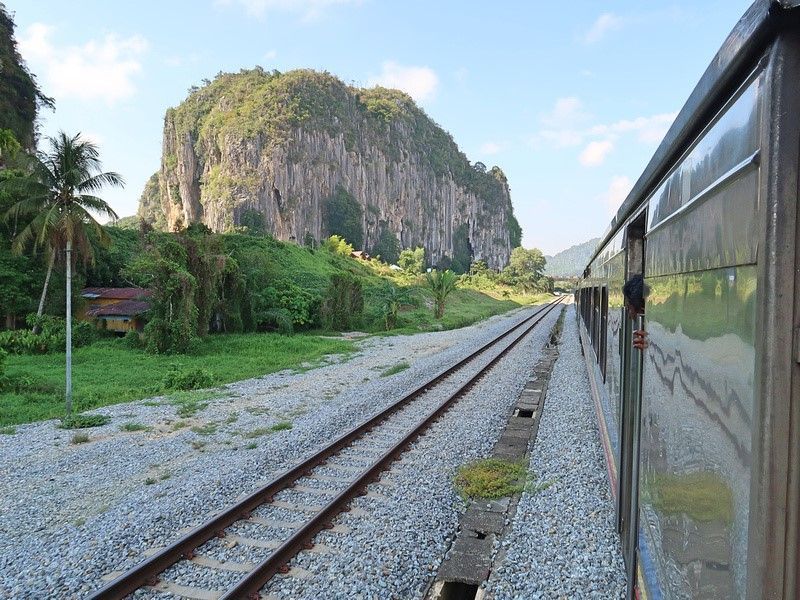
Despite the imminent arrival of the new trunk line, the existing narrow-gauge East Coast Line is being kept in perfect condition. (Source: www.nomadicnotes.com. Photograph: James Clark)
Second, there is the completion of electrification and the construction of a second main track on the West Coast Line (between Keluang and Johor Bahru), planned for the end of 2025. At the same time, under a separate project, by December 2026 Johor Bahru will once again be connected with Singapore (the Woodlands railway checkpoint) by a double-track 1,435 mm gauge railway, replacing the section of the West Coast Line linking the two countries that was closed in 2011 owing to disputes between KTM and the Singapore authorities.
Third, there is the slow but steady modernization of the JKNS railway in the state of Sabah, comprising the reconstruction of infrastructure and the renewal of rolling stock. An expansion of the local network is also possible, including the restoration of previously dismantled sections.
And finally, the development of suburban and urban rail transport continues — not only in Kuala Lumpur but also in the north of the country: by 2031 a new LRT line almost 30 km long will connect the city of George Town, on the island of Penang, with the mainland.
A joint project of 1520International and the Institute for Economics and Transport Development (IETD)
 Read next content