
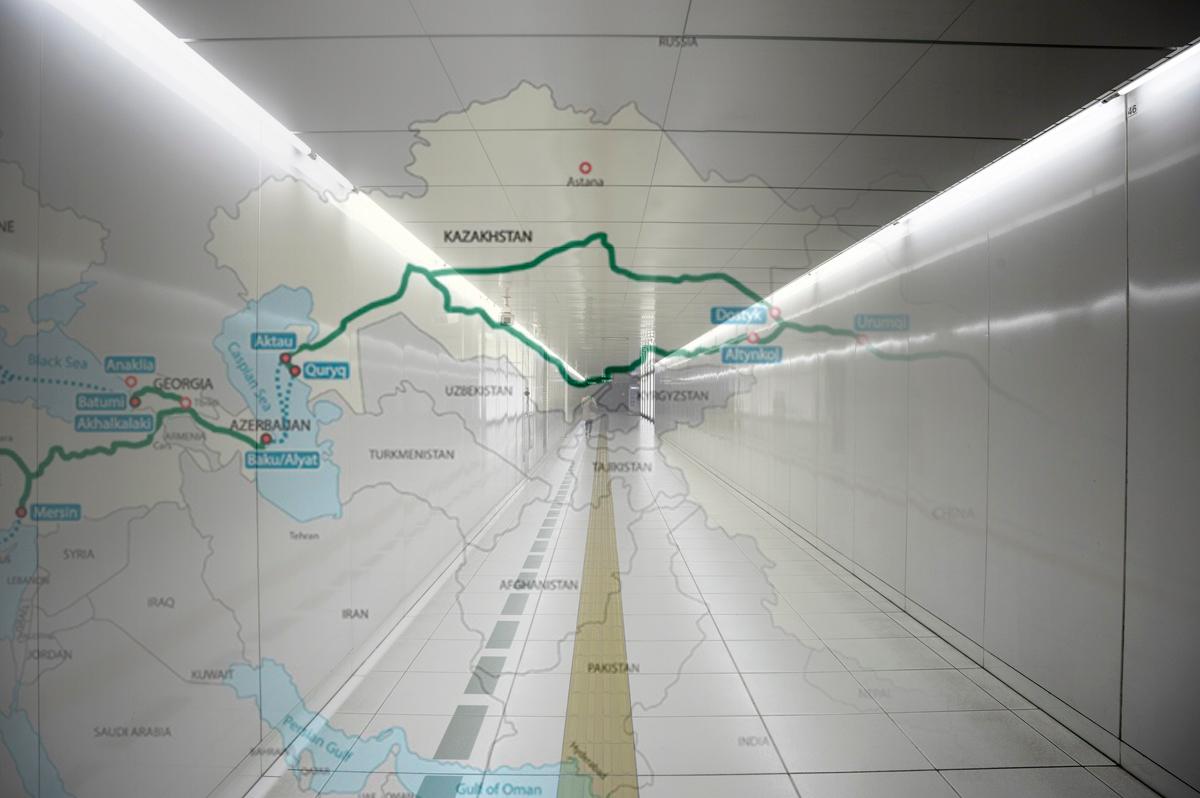
Kazakhstan, Azerbaijan, and Georgia are working to create a unified tariff model for the Trans-Caspian International Transport Route. President Kassym-Jomart Tokayev of Kazakhstan announced this on 24 June at a meeting with Eduard Sigrist, senior vice-president of Mediterranean Shipping Company (MSC).
A TARIFF NORM
Developing the TITR is a strategic priority for Kazakhstan today, Tokayev said during the talks. The projects MSC is carrying out on the country’s Caspian coast, he noted, “will significantly enhance the route’s competitiveness and drive growth in freight volumes between Asia and Europe.”
According to Sigrist, the company’s long-term investment plans in Kazakhstan span logistics terminals, rail assets, port infrastructure, maritime services, and air cargo.
Through tariffs are a well-established way to make international transport routes more commercially attractive. They ease financial planning and simplify shipping paperwork. Such a system already operates on the North–South International Transport Corridor: on the eastern branch, which runs through Kazakhstan and Turkmenistan, a through tariff took effect in 2023. The agreement between Russian Railways (RZD) and the Azerbaijani and Iranian railways to introduce a through rate on the western route was signed in November 2025, at the 83rd meeting of the Council for Rail Transport of the CIS Member States.
A CORRIDOR AT A POINT OF BIFURCATION
The Trans-Caspian International Transport Route is a multimodal corridor carrying cargo to Europe through Kazakhstan, the Caspian Sea, Azerbaijan, Georgia, and Turkey—and it badly needs to become more competitive. As Kazbek Maigeldinov, chairman of the “Association of China Researchers” foundation (Kazakhstan), noted at the round table “The New Axis of Trade: Today’s Main Logistics Routes” this past May, the TITR’s freight flow grew fivefold between 2021 and 2025 (from 840,000 to 4.12 million tons). Even so, the China–Europe–China transit route across Russia “retains an overwhelming edge on every count,” from the level of infrastructure to the convenience of delivery without repeated transshipment.
Right now, Maigeldinov says, the TITR sits at a point of bifurcation. The investment its development requires is put at €19 billion (the EBRD’s estimate). On one hand, that development is propelled by powerful geopolitical momentum and by China’s drive to diversify its routes. On the other, the corridor remains structurally fragile: its capacity is 20 to 30 times lower than the northern route’s, and its costs are higher. The shrinking of the Caspian adds further risk.
“There are forecasts that, with the necessary investment and structural reform, the Middle Corridor could triple its freight flow to 11 million tons and halve transit time by 2030. I think this route should be seen as the third element in Eurasia’s emerging multi-corridor architecture,” Maigeldinov says.
REACHING A NEW LEVEL
Talk of a single tariff on the Trans-Caspian route has been going on for more than a decade, notes Alexander Karavaev, an expert at the Caspian Institute for Strategic Studies—and so has the debate over creating a single operator for the corridor. “Practitioners say it may already be time to bring in an outside carrier and give it the authority to act as the route’s principal operator,” the expert told 1520International.
Infrastructure coordination on the Trans-Caspian route is good enough for local carriers but not for large-scale Eurasian transit, Karavaev says. To turn the TITR into a world-class transport system, the authorities need to lean on major logistics players and investors—and that means bringing the regulators and infrastructure operators (which, among other things, negotiate tariffs and cargo-movement regimes) into line with international standards, the analyst notes.
Whether the proposed measures will draw additional transit cargo to the TITR is an open question, hinging above all on how actively the biggest extra-regional players—the European Union and China—engage. In-region freight, meanwhile, will inevitably grow as economic integration deepens, whether or not extra Eurasian transit can be captured. Given the brisk growth of the Caspian economies, one can safely say demand for the TITR will keep rising, Karavaev reasons.
Dmitry Koptev
- April 2026
- October 2026
- September 2026
- August 2026
- July 2026
- June 2026
- May 2026
- February 2026
- January 2026
- December 2025
- November 2025
- October 2025
- September 2025
- August 2025
- July 2025
- June 2025
- aprel-2025
- March 2025
- February 2025
- January 2025
- December 2024
- November 2024
- September 2024
- August 2024
- July 2024
- June 2024
- May 2024
- April 2024
- March 2024
- February 2024
- January 2024
- December 2023
- November 2023
- October 2023
- September 2023
- August 2023
- July 2023
- June 2023
- May 2023
- April 2023
- March 2023
- February 2023
- January 2023
- December 2022
- November 2022
- October 2022
- September 2022
- August 2022
- July 2022
- June 2022
- May 2022
- April 2022
- March 2022
- February 2022
- January 2022
- December 2021
 Read next content