
The history of Bolivia's railways dates back to the 1840s, when the need arose to transport the large volumes of saltpetre mined in the country. In 1856, President Jorge Córdova announced a tender for the construction of the Cobija–Calama railway and concluded an agreement between Bolivia and Peru on connecting Tacna and La Paz by the “Camino” road. In 1867, the decision was taken to build the Cobija–Aduana line, a year later the Cobija–Potosí line, and in 1869 the La Paz–Aigachi line. None of these attempts, however, met with success.
The first steam-hauled railway appeared in Bolivia only in 1873. This was a short, 762 mm gauge branch from the Salar del Carmen saltpetre deposit to Antofagasta, built by the Anglo-Chilean company Compañía de Salitres y Ferrocarril de Antofagasta.

View of the railway tracks at the port of Antofagasta, 1876. (Source: Wikimedia Commons. Drawing: T. Taylor)
In 1879, a conflict erupted between the Bolivian parliament and the aforementioned company. The Chilean government took the side of its national and, backed by Great Britain, opened hostilities against Bolivia and its ally Peru. The War of the Pacific (or Saltpetre War) lasted until 1883 and ended in the defeat of the allies. Antofagasta, together with the lands through which the railway ran, passed to Chile for good (by the outbreak of the war the line had been extended as far as Salinas Station, 98 km from Antofagasta). Bolivia thus lost its access to the sea and was once again left without rail communication.
At the same time, commercial interests prevailed over inter-state differences. After the signing of a truce agreement, the Bolivian silver-mining company Compañía Minera de Huanchaca and the Compañía de Salitres y Ferrocarril de Antofagasta concluded a contract in 1885 to extend the railway from Salinas to the state border, in order to export the Bolivian company's output through the port of Antofagasta. Two years later the line reached the border, which aroused the fears of Bolivians, who held that the railway was of military rather than commercial interest. President Gregorio Pacheco (the well-known “silver magnate”), however, approved the extension of the line from Ascotán to the Bolivian city of Oruro on 19 July 1887.
An unexpected move was the purchase by Compañía Minera de Huanchaca of the entire railway, using a loan taken out from the British company Antofagasta (Chile) and Bolivia Railway Company, Ltd, formed in London on 28 November 1888. The construction of the Antofagasta–Uyuni line, 612 km in length (of which 170 km lay within Bolivian territory), was completed in 1889. In addition, the company built at its own expense the branches Pulacayo–Uyuni (36 km) and Pulacayo–Huanchaca (12 km), with a tunnel almost 3 km long. And in 1892 the railway reached the city of Oruro, at the 925th kilometer of the line.
This railway, crossing the Central Andes and running at an altitude of 3.7 km above sea level, is an outstanding feat of engineering. It was perhaps the first time that a railway line with a gauge of just 2.5 feet (762 mm) had served as a long-distance main line. Moreover, it carried not only freight traffic but also the international “International” express, with sleeping cars and a dining car.
The role of the Antofagasta–Oruro railway in Bolivia's history is a contradictory one. For the mining industry, the railway made it possible to reduce the cost of raw materials (especially fuel) and to increase export volumes, rendering the transport of lower-silver-content ore competitive. On the other hand, it dealt a blow to the food industry, allowing imported flour to displace the flour produced in Cochabamba, and imported sugar to replace the local sugar made in Santa Cruz.

An English Kitson-Meyer freight steam locomotive by Beyer Peacock, 1913. Locomotives of this type worked on the Antofagasta–Oruro line from 1894 to 1928 alongside American Baldwin steam locomotives. (Source: Wikimedia Commons)
Meanwhile, in 1904 the Treaty of Peace and Friendship between Bolivia and Chile was finally concluded. As compensation for the territories lost by Bolivia, Chile undertook to build the Arica–La Paz railway (1,000 mm gauge), 390 km in length (of which 233 km lay within Bolivian territory). Its construction was completed in 1913. La Paz, the country's de facto capital, thereby gained the shortest route to the Pacific Ocean.
And in 1908, with the support of the Bolivian government, construction began on a meter-gauge line from Oruro to the junction station of Viacha near La Paz (202 km in length), also completed in 1913. The coexistence of tracks of different gauges on the Antofagasta–La Paz route, however, created inconvenience. For this reason, as soon as traffic opened on the Oruro–La Paz section, the regauging of the rest of the main line began. In 1916 the work was suspended for lack of funds, and the entire line was converted to the new gauge only by 1928. Since by that time the company had accumulated sufficient experience in changing the bogies of freight wagons, some of the 762 mm gauge branches were left unconverted and remained in operation until the 1960s.
The first three decades of the 20th century were the most fruitful period in the development of Bolivia's railways. By 1925, more than 50% of the lines had been built with the participation of British capital. Some of them were oriented toward the foreign market and were therefore tied to mineral extraction (in the early 20th century the “silver boom” gave way to a “tin boom”). Such lines included, in addition to the main lines mentioned above, the 98 km Viacha–Guaqui line, with access to the Peruvian railway network via a ferry across Lake Titicaca, and two important branches that had a major impact on the mining regions: Río Mulatos–Potosí (174 km) in 1912 and Uyuni–Atocha (90 km) in 1913. Another group of lines provided for the integration of the country's interior regions. Foremost among these was the Oruro–Cochabamba line, 205 km in length, built between 1906 and 1917 at a record cost of £3,898,080 (now no longer in existence). The Atocha–Villazón line (206 km) also deserves mention, which between 1915 and 1925 linked Bolivia with Argentina.

Railway repair and machine workshops in Uyuni, around 1925. (Source: flickr.com, uploaded in 2011 by Victor Tropa)
Not all projects, however, were realized. For example, it never proved possible to build the railway between Bolivia's largest cities, Cochabamba and Santa Cruz de la Sierra, construction of which began in 1928 and was left unfinished. And the extension of the Río Mulatos–Potosí railway to the country's official capital, the city of Sucre, begun in 1916, was completed only in 1935.
Thanks to the construction of new lines in the 1920s, it proved largely possible to revive the regional markets that the railways had adversely affected in the late 19th and early 20th centuries (Cochabamba flour, for instance, returned to the domestic market). Furthermore, the strengthening of rail communication between Bolivia, Argentina, and Chile led to the development of cattle exports from the Tarija Department to Argentina.
In 1930, the length of Bolivia's railway network stood at 2,233 km. Some 58% (1,294 km) was in the hands of foreign companies, 6% (144 km) belonged to Bolivian mining companies, and 36% (795 km) were state lines. Some of the state railways, however, had in turn been leased to foreign companies. Such a diversity of operators had an adverse effect on the standardization of rolling stock and impeded the pursuit of a unified transport policy.

A bridge on the Potosí–Sucre railway line near Nucchu, 1931. (Source: Wikimedia Commons. Photograph from an exhibition at the Casa de la Libertad, Sucre (Bolivia), 2012)
The crisis in the mining industry brought on by the Great Depression, which began in 1929, had an adverse effect on the railways. In 1932–1935, however, during the Chaco War between Bolivia and Paraguay, traffic volumes and the companies' revenues grew thanks to the carriage of troops, ammunition, and provisions for the army.
The eastern part of Bolivia still remained without rail communication. For this reason, in 1938 the country's leadership set the task of connecting the Santa Cruz Department with the Atlantic by means of the railways Santa Cruz de la Sierra–Yacuiba (517 km) to the border with Argentina and Santa Cruz de la Sierra–Corumbá (600 km) to the border with Brazil, respectively.
The surveying of the Santa Cruz de la Sierra–Yacuiba line was paid for by the Bolivian government, and its construction by the Argentine government, financed through deliveries of Bolivian oil. The Bolivian National Revolution of 1952, however, delayed construction, and the line opened on 19 December 1957, fifteen years after work had officially begun.

The Santa Cruz de la Sierra–Yacuiba railway line as it appears today, January 2015. (Source: griphon.livejournal.com. Photo: G.E. Krasnikov)
As for the Santa Cruz de la Sierra–Corumbá line, it was financed in part out of the £1 million that Brazil had allocated to Bolivia for railway construction as far back as the Treaty of Petrópolis on territorial demarcation of 17 November 1903 (!), and from the advances that Brazil provided to Bolivia for construction in 1938. As in the case of Argentina, these loans were repaid thanks to Bolivian oil. The first train from Brazil arrived in Santa Cruz de la Sierra in November 1953, but the railway was put into operation only on 5 January 1955, seventeen years after work had begun. The completion of bridges and other minor works continued until 1970.
To this day the western (or Andean) and eastern railway networks are not connected to each other within Bolivian territory. The only link between them is the Argentine railways.
Between 1952 and 1964, the greater part of fuel haulage by rail ceased on account of the construction of oil pipelines, and the carriage of sugar and rice on account of the development of road transport; passengers increasingly switched to buses. Bolivia's railways fell into decline. As in the 19th century, the future of the country's railway transport was once again bound up with the output of the mining industry and the export sector of the economy.

The ruins of a station building on the La Paz–Yungas railway branch, dismantled in the 1960s, 16 February 2008. An advertisement is visible for the local beer Paceña — the most popular in Bolivia. (Source: flickr.com)
In 1962–1964, the Antofagasta to Bolivia Railway (FCAB) and the Bolivia Railway Company were nationalized, with the creation of the National State Railway Company (ENFE), to which the lines of the eastern network were subsequently also transferred.
In 1967, the Joint Bolivian-Argentine Commission proposed extending the Yacuiba–Santa Cruz de la Sierra line northward in order to reach the Yapacaní River in the Amazon basin and build a river port. Its initial section to Santa Rosa, 106 km in length, opened on 1 October 1970, while the section to Yapacaní (105 km) remains unfinished to this day.
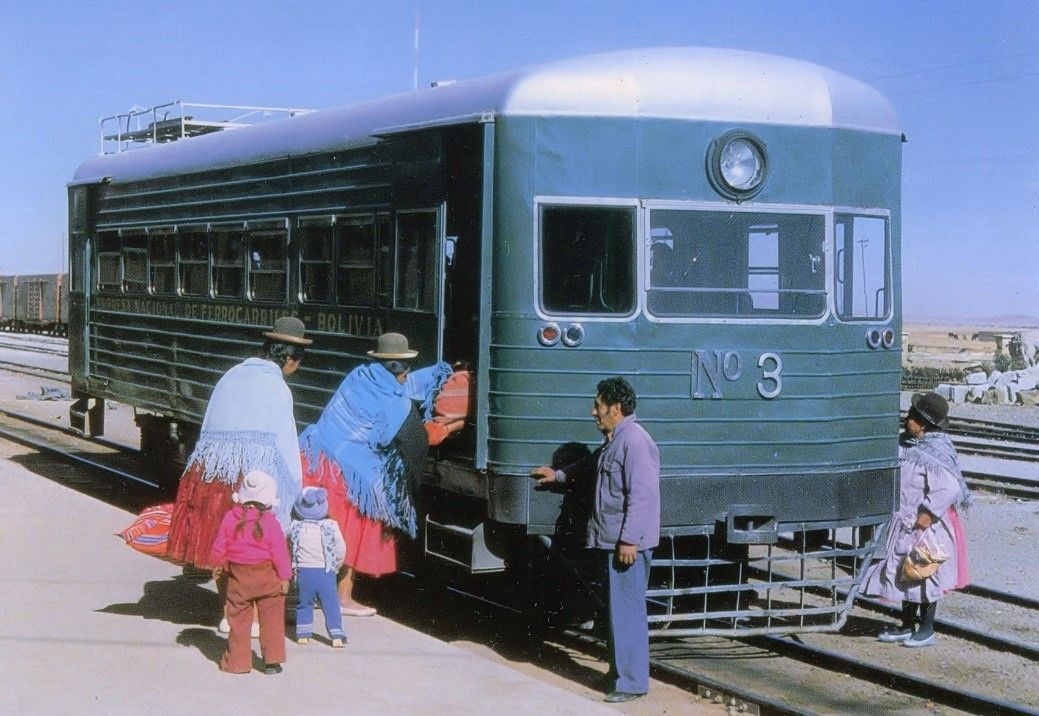
Although the conversion of the country's railways to diesel traction had begun in 1958 (the FCAB lines), as of 1971 steam locomotives still made up the overwhelming share of the country's locomotive fleet (92 units against 29 diesel locomotives), and almost half the steam locomotives were of pre-war manufacture. In addition, the network had 12 railbuses, 198 passenger carriages (almost all pre-war), and 1,843 freight wagons (two-thirds of them pre-war). To address the problem of renewing the rolling-stock fleet and modernizing the infrastructure, in the 1960s and 1980s the ENFE received loans from the World Bank and the Japan International Cooperation Agency (JICA), as well as technical assistance from the United Nations Development Program (UNDP).

A railbus built in 1953 by the English firm Wickham / Leyland at Viacha Station, August 1981. (Source: flickr.com, uploaded in 2013 by Albrecht Sappel)
The volume of freight carried by the ENFE between 1965 and 1995 fluctuated with the state of the Bolivian economy, but by 1995 it had grown to exceed 1.3 million tons. Over this period the volume of freight carried by the eastern network became increasingly significant. Whereas in 1965 it amounted to just 9.9% of the ENFE's total traffic, by 1995 this figure had reached 50%.
The number of passengers carried by the ENFE between 1965 and 1995, by contrast, fell by almost a third. Whereas in 1965 more than 1.6 million passengers were carried, in 1995 their number amounted to just 0.65 million. But, as in the case of freight, the relative importance of the eastern network grew over this period: in 1995 it accounted for 45% of the passengers carried.
In 1995, in the context of the neoliberal reforms of President Gonzalo Sánchez de Lozada, the privatization of the railways began. The state retained ownership of the infrastructure and received license payments for the concession. As a result, the ENFE railway system was divided into two companies: Empresa Ferroviaria Andina S.A. (based on the Andean network) and Empresa Ferroviaria Oriental S.A. (based on the eastern network).

The Santa Cruz de la Sierra–Yacuiba railway line as it appears today, January 2015. (Source: griphon.livejournal.com. Photo: G.E. Krasnikov)
The privatized companies met their investment obligations; in addition, the average speed of trains increased, the number of accidents declined, and the cost of carrying freight fell. In 2015, freight traffic grew to 2.8 million tons (more than doubling over 20 years). Passenger fares rose, however, partly on account of reduced subsidies. The number of passengers carried fell to 0.29 million in 2015 (more than halving over 20 years). A number of loss-making lines were also closed; even La Paz and Cochabamba were left without rail service.
Nevertheless, in 2014 a 65 km freight branch was opened from the Antofagasta–Uyuni railway line to the concentrator plant of the company Minera San Cristóbal, for the transport of zinc-silver and lead-silver concentrates. And in 2019 a significant event was the purchase of new diesel locomotives — for the first time in 40 years.
Projects in the field of passenger transport are also being implemented. In the city of Cochabamba, on 13 September 2022, the first phase of a light-rail line (more than 40 km of track) opened, running along the route of a dismantled railway and connecting the city with the suburbs of Suticollo and El Castillo and with the University of San Simón. For the first time in the country's history, the 1,435 mm gauge was used. Rolling stock of Belarusian manufacture was purchased, from the company Stadler Minsk, with three-section cars holding 200 passengers.
In addition, in the second half of 2025 it is planned to resume the railbus service — interrupted during the coronavirus pandemic — on the repaired, isolated Cochabamba–Aiquile railway section, formerly part of the Andean network.
A joint project of 1520International ande the Institute for Economics and Transport Development (IETD)
 Read next content