
The history of Cuba's railways began in 1830, in the era of Spanish dominion, when the Captain-General of Cuba, Francisco Dionisio Vives, created a Railway Board to study the question of building the Havana–Bejucal–Güines line. In December of that year, consideration of the project was suspended and resumed only in 1832, when Claudio Martínez de Pinillos, Count of Villanueva, was appointed President of the Royal Development Board of Havana. Finally, on 12 October 1834, the Count of Villanueva obtained the permission of the Queen Regent of Spain, María Cristina, to build the first railway, from Havana to Bejucal, 27.5 km in length, having secured a loan of 2 million pesos. The chief engineer of the project was the American Alfred Kruger.
The first steam-hauled train set out from the Ciénaga workshops in Havana on a trial run on 13 November 1837 and arrived at Bejucal at 10:18 a.m. The ceremonial opening of the first section took place on 19 November 1837.

Bejucal railway station (Cuba), 2002. (Source: Wikimedia Commons)
Cuba thus became the seventh country to have railways, just 12 years after the opening of the world's first public railway, the Stockton and Darlington in Great Britain, and a week after the opening of the St. Petersburg–Tsarskoye Selo line in Russia. In the metropole itself — Spain — this mode of transport would appear only in 1848. The Havana–Bejucal railway line became the first railway in Latin America and the second in the New World (after the United States). It is also of interest that the Cuban colonial administration chose the 1,435 mm gauge from the outset, even though in the homeland of the “Stephenson” gauge, Great Britain, the law making its use mandatory (the Regulating the Gauge of Railways Act) was not passed until 1846.
By the end of 1839, Cuba's first railway had been extended by a further 44.5 km, reaching its intended destination — the city of Güines, the center of a rich agricultural region to the southeast of Havana.
The development of railways in Cuba was stimulated by the growth of the sugar industry, which needed efficient transport to carry sugar and molasses (“cane honey”) to the ports for export. In addition to the Havana railway network, local networks developed rapidly, beginning with Matanzas, Cárdenas, Cienfuegos, Caibarién, and Sagua la Grande in the west and center of the island — that is, where sugar production was concentrated.

“La Junta” — the first locomotive (in service since 1 November 1843) of the Compania del Ferrocarill de Matanzas, in the Havana railway museum, 20 March 2014.
(Source: Wikimedia Commons. Photo: Lukasz Katlewa)
In the west of the country, in 1842 the Havana–Bejucal–Güines line was sold at auction to the company the Havana Railways, which over 15 years managed to build around 100 km of lines. In 1848, the company connected its network with the Matanzas Railway, making rail communication between the two cities possible for the first time.
The second port city after Havana to gain a railway was Cárdenas (in December 1840 a line opened to Bemba Station, now the city of Jovellanos). In 1843, the Cárdenas Railway linked up with the Júcaro Railway, and as early as 1849 it intersected with the Matanzas Railway. By 1888, the railway network, advancing to the southeast, reached Yaguaramas (the town of Aguada de Pasajeros). The nearest competitors did not lag behind either: the Matanzas Railway likewise expanded its network in a southeasterly direction to Colón (1872) and on to Esles Station in the vicinity of the town of Rodas (1886).

The old Cárdenas railway station (Cuba). (Source: www.tripadvisor.ru)
In parallel, the development of Havana's rail transport continued. Havana became the second city in Latin America to acquire a tram system (losing out to Mexico City by only a few days!). Horse-drawn tram services were launched on 3 February 1858, the first steam tramway line began operating in 1873, and the first electric line in 1901. In 1861, the first section of the Western Railway opened in the suburbs of Havana; it reached its terminus, the city of Pinar del Río, only in 1894, attaining a length of 200 km. Construction of the railway running in the opposite direction proceeded much faster: its initial section was opened by the company the Havana Bay Railways in 1860, and as early as 1869 the line, more than 300 km in length, reached Santo Domingo in the central part of the island. By 1892, all the railway companies based in Havana, with the exception of the Western Railway, had been absorbed by United Havana Railways Company, controlled by English capital.

One of the cars of the Havana Electric Railway. The unusual feature of the Havana tram was its two-wire overhead contact system, similar to that of a trolleybus. (Source: www.tramz.com)
In the central part of Cuba, the first railway line, in 1851, connected the port of Cienfuegos on the southern coast with Palmira; it reached Villa Clara (now Santa Clara) in 1860. On the northern coast, the first section was also opened in 1851, between the port of Caibarién and Remedios. It was subsequently extended to the southwest, reaching San Andrés near Placetas in 1871. This port also became the starting point of the Caibarién–Zulueta–Placetas narrow-gauge railway (1878).
The most extensive network of railway tracks in central Cuba, however, would be created at Sagua la Grande. There the first section was laid in 1855, between the port of Isabela (Concha Station) and the village of Sagua, and in 1860 the line connected with the Cienfuegos railway. As a result, rail communication between the northern and southern coasts in the center of the country was established for the first time. In 1890, this network linked up at Camajuaní with the Caibarién Railway. Nine years later, all three central companies merged into the Cuban Central Railway, with its headquarters in Sagua la Grande.
Unlike the western and central parts of Cuba, the eastern part of the island (to the east of Santa Clara and Caibarién) had no developed railway network before 1898. This was hindered by such factors as the lower population density, the more difficult physical and geographical conditions, the weak development of the sugar industry, and the first (“Ten Years'”) Cuban war of independence (1868–1878).

A narrow-gauge railway in the area of the town of Yaguajay, around 1896.
(Source: Robert Percival. Industrial Cuba: being a study of present commercial and industrial conditions with suggestions as to the opportunities presented in the island for American capital, enterprise and labour. New York: Putnam, 1899)
Nevertheless, the second railway in Cuba to receive a construction concession (on 10 January 1837) was the line from Camagüey (then called Puerto Príncipe), one of the most important cities in the east of the island, to the port of Nuevitas on the northern coast. Although construction of the 72 km line began as early as 1836, it was completed only in 1851. Its concessionaire was Gaspar Betancourt Cisneros (1803–1866) — the son of a wealthy planter from Camagüey, a celebrated revolutionary, writer, and founder of Cuban journalism. Interestingly, the famous A.A. Betancourt (1758–1824), a Spanish and later Russian statesman and scholar, also belonged to this same noble family.
Speaking of eastern Cuba, mention must also be made of the railway that crossed the Sierra Maestra mountain range and connected the island's second most populous city — Santiago de Cuba — with San Luis, Alto Songo, and Ponupo (La Maya). Its construction was carried out between 1859 and 1865.
Thus, over 60 years of railway construction in Cuba, despite impressive achievements, the Spanish colonial authorities never concerned themselves with creating a unified railway network on the island.
The last quarter of the 19th century was marked for Cuba by great upheavals. Although the “Ten Years'” War ended in defeat for the supporters of Cuban independence, slavery was abolished on the island in 1886, and the planters who relied on forced labor gave way to several large sugar holdings. As a result of a new “Cuban War of Independence,” which began in 1895 and was supported by the United States, Spain was utterly defeated and in 1898 lost power over the island.
That same year saw the start of construction of the railway connecting Santa Clara with Santiago de Cuba, 573 km in length, which ran largely along the longitudinal axis of the island. The work was carried out in record time. The new railway was officially opened on 22 November 1902 by the first President of Cuba, Tomás Estrada Palma, who had taken office in May of that year following the end of the temporary American occupation. On 15 November 1903, the first through passenger train set out from Havana to Santiago de Cuba, covering a distance of almost 900 kilometers in 25 hours. And on 30 November 1912, on the site of the former Arsenal, beside the port, the monumental building of the new Central Station of Havana was opened, built by the American architect Kenneth MacKenzie Murchison.

The Central Station of Havana, around 1915. (Source: Wikimedia Commons. Photo: Ramon Corral)
In the first quarter of the 20th century, the expansion of the network continued throughout the country. Thus, the Cuba Railroad, whose headquarters and workshops were located in the city of Camagüey, united all the local lines of eastern Cuba into a single network. This facilitated an influx of population into the Guantánamo Valley and the Central Valley in the eastern half of the island. The Western Railway in 1908 reached Guane at the opposite end of the island. Cut-off lines were also being actively built.
Finally, in 1919 one of the island's major cultural centers, the city of Trinidad, was connected to the railway network. For this, a 90 km branch was built from Placetas, through the Escambray mountain range at the Agabama River, on which a bridge was erected — the longest in Cuba and one of the largest in Latin America, 52 m high and 250 m long. This branch operated until 1988, when the bridge was swept away by a flood on the river.
In 1916–1922, the North American company Hershey built the first electrified railway in Cuba, between Havana and Matanzas, running not far from the northern coast. It was intended to serve the company's sugar mills and to provide passenger services. Today this, the only electrified line in Cuba (with a network voltage of 1,200 V DC), is a popular tourist attraction thanks to its picturesque scenery.

As recently as 2012, American electric trains that had been operating since the line's launch could still be encountered on the Hershey railway. (Photo source: news.rambler.ru)
The last major railway construction in Cuba was the Northern Railway between Nuevitas and Santa Clara, initiated by José Miguel Tarafa, an entrepreneur and former colonel of the Liberation Army. It served as an alternative to the central line in the eastern part of the country. The lines and branches of this railway, with a total length of 330 km, were put into operation in stages from 1917 to 1927.
By 1930, Cuba's railways had reached the peak of their development. The construction of new lines then practically ceased, owing to growing competition from road transport, as well as the impact of the global economic crisis of the 1930s and the stagnation of the sugar industry.
Excessive competition and the irrationality of designing parallel networks, combined with a difficult economic situation, led to a process of mergers between the various railway companies. During the military dictatorship of Fulgencio Batista (1952–1959), the west of the island was dominated by the state-controlled Western Railways of Cuba, and the east by the Consolidated Railroads of Cuba, under the control of North American capital. During this period the replacement of steam traction by diesel began, and by 1959 some 164 diesel locomotives were already at work on the main-line network, predominantly of US manufacture (on the sidings of sugar mills the first diesel locomotives had appeared as far back as before the Second World War).
By this time, the operational length of the public railway network amounted to 4,737 km, and its route length to 5,278 km. The density of the network was 51 km per 1,000 sq km (the highest figure in Latin America, comparable to those of developed European countries). In addition, the island had 184 non-public railways, with a total route length of 9,229 km, of which 3,830 km were narrow-gauge lines (gauges of 914, 864, 762, 704, and 610 mm), operated predominantly by the sugar industry.

Narrow-gauge steam locomotives at the Sugar Museum (Cárdenas), preserved on the initiative of the Cuban revolutionary Raúl Castro. (Source: Vulfov, A. Railway Cuba // Lokotrans. 2007. No. 11. pp. 24–28)
On 30 June 1961, following the victory of the Cuban Revolution, the United Company of National Railways was created, which was subsequently reorganized into the Cuban Railway Union. The imposition of the American embargo against Cuba made it difficult to acquire new equipment and spare parts of US manufacture. The country's economy reoriented itself toward ties with the Soviet Union and other socialist countries (from 1972, within the framework of the Council for Mutual Economic Assistance), including cooperation in the railway sector.
In 1972, a new Program for the Development of Railway Transport in Cuba was drawn up. The most ambitious project here was the reconstruction of the Havana–Santiago de Cuba main line, carried out between 1974 and 1984 with the assistance of Soviet specialists. Some 1,291 km of track, 229 bridges and overpasses, and all the passenger and technical buildings were reconstructed. The first section of the modernized main line was opened in person by Fidel Castro at Placetas on 29 January 1975, hauled by a Soviet M62K diesel locomotive. It is important to note that the reconstruction involved rerouting the line over roughly a third of its length. Individual sections were straightened and curve radii increased (to a minimum value of 2,000 m). The length of the line was reduced from 862 to 835 km, and the maximum speed of passenger trains was raised to 140 km/h. Second tracks were laid on the approaches to major cities, and at Santa Clara a bypass of the railway junction was built.

A TEM4 diesel locomotive built by the Bryansk Machine-Building Works in 1965, with a freight train on the reconstructed Havana–Santiago de Cuba railway.
(Source: railgallery.ru)
After the collapse of the socialist bloc and the dissolution of the USSR in 1991, the Cuban economy entered a protracted crisis, known in the country as the “Special Period,” which had serious consequences for the railways. Furthermore, in 2002–2006, with the closure and demolition of more than half the country's sugar mills, the length of the departmental railway lines was significantly reduced (by almost two-thirds). Soon afterward the Ministry of Sugar was abolished, and its railways were incorporated in 2011 into the public railway network.
Following the revival of the Cuban economy from 2000, small batches of locomotives and carriages, mostly second-hand, were purchased from France, Germany, Spain, and Mexico. From 2006, however, China became the leading supplier of railway equipment to Cuba; in that year Cuba received its first 12 new Chinese DF7GC-type diesel locomotives of 2,500 hp, and as a result of subsequent orders a further 100 locomotives of this series and 5 DF7KC diesel locomotives (1,400 hp) were delivered by 2010. Equipment for the major overhaul of Cuba's railways was also purchased in China.

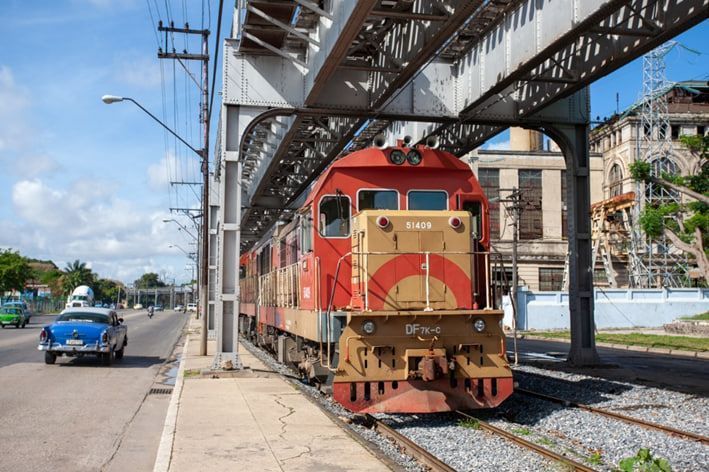
Chinese DF7K-C diesel locomotives at the Central Station of Havana, beneath the viaduct of the Havana tram, closed in 1952, 6 March 2014. (Source: railgallery.ru)
In 2014, for the first time in many decades, a new railway opened in Cuba. This was the double-track line from Havana to the container port of Mariel, with a total length of 71 km, running in part along the route of the former Guanajay Railway. Construction had been begun as far back as the 1980s and suspended in the 1990s on account of the “Special Period.” The new line is used for both freight and passenger traffic.
An important event for Cuba was the resumption of Russo-Cuban cooperation in the field of railway transport after a quarter of a century. In 2016, the company RM Rail delivered 363 freight wagons to the island, and the following year a further 225 wagons; the Murom Locomotive Works delivered SV10-series railcars in 2013. And under the terms of a contract signed in Havana on 23 July 2016, the company Sinara Transport Machines manufactured for Cuba, between 2017 and 2020, 60 TGM8KM-series shunting diesel locomotives from the Lyudinovo Locomotive Works.
The participation of Russian specialists in the modernization of the country's railways is also envisaged, under the Agreement between the Government of the Russian Federation and the Government of the Republic of Cuba on cooperation in the restoration and modernization of the railway infrastructure of the Republic of Cuba, which entered into force on 13 March 2024. All of this gives grounds for hoping that relations between the railway workers of the two countries, with their glorious traditions, will be strengthened and expanded.
A joint project of 1520International and the Institute for Economics and Transport Development (IETD)
 Read next content