
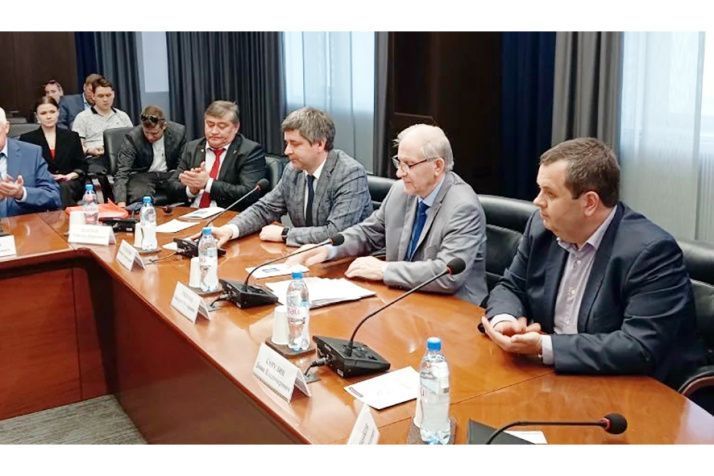
From May 27 to 30, Krasnoyarsk hosted the 21st International Research-and-Practice Conference “Logistics—The Eurasian Bridge.”
The event brought together researchers and students from a range of research and academic institutions in Russia, Belarus, Kazakhstan, China, and other countries.
As in past years, the conference was organized by Krasnoyarsk State Agrarian University (KSAU) with support from Siberian Federal University and the Siberian branch of the International Center for Logistics.
“The ‘Logistics—The Eurasian Bridge’ conference has become one of the notable scholarly traditions in applied logistics, at both the Russian and international levels. For more than two decades now, we’ve been discussing how approaches to logistics are changing in today’s world and tracking the latest trends in methodology and practice,” said Valery Lukinykh, professor at KSAU and deputy chair of the conference’s organizing committee.
The conference drew active participation from researchers at Russia’s transport universities, including the Russian University of Transport (RUT MIIT) and the railway universities of St. Petersburg, Novosibirsk, and Samara, as well as representatives of several Russian Railways departments. RUT MIIT’s Anna Sinitsyna and Alexei Nekrasov, in particular, focused their paper on the cutting-edge topic of process interoperability in transport and logistics systems. They argue that in today’s business environment, interoperability is especially valuable—the ability of every participant in a transport-and-logistics system (shippers, carriers, warehouse operators, government agencies, and so on) to work together seamlessly through shared standards and technologies built on the principle of integration. Interoperability, they note, rests on three fundamental pillars: the adoption of global data-exchange standards (GS1, EDI), the use of technological integration solutions (API, ESB), and the creation of a unified information space modeled on national digital platforms.
A joint paper was presented by Inessa Yakovleva—deputy head of the Informatization Department and head of the automated freight-traffic management systems division at Russian Railways—and Vladimir Shcherbakov, head of the Department of Logistics and Supply Chain Management at St. Petersburg State University of Economics (SPbSUE). It explores how artificial intelligence is enhancing customer services and skills in rail freight logistics. The authors note that Russian Railways is firmly holding onto the lead it established early on in digital transformation, both within the transport sector and across the economy as a whole. Pilot projects that have been tested on the RZD network and proven their effectiveness make a strong case for bringing training versions into the classroom so students can build their skills with AI solutions. One successful example of innovative technology in workforce training is the training of logistics specialists for Russian Railways using the software and technology resources of the Artificial Intelligence and Digital Logistics Laboratory established at SPbSUE.
Elizaveta Bolshakova of Siberian State Transport University focused her research on assessing the Northern Siberian Railway Mainline (SevSib) project. She points out that the complex geopolitical situation has kept construction from starting just yet, but the importance of building the line remains high: it could relieve pressure on the Trans-Siberian Railway, provide additional transport corridors, and secure independent access to the world’s oceans through ports on the Arctic Ocean—an essential condition for free trade with countries around the world.
International transport corridors emerged as one of the conference’s recurring themes in 2026. Yadukrishnan Preshid, director of Techbridge Exim Pvt Ltd (Kerala, India), used his presentation to explore BRICS cooperation in logistics flows and the development of the India–Russia transport corridor.
A researcher from Gabon, Brigitte Sabrina Avomo Obiang Noack, addressed the development of Africa’s transport and logistics infrastructure, including systemic constraints and regional imbalances.
The conference also featured the Valeria Ermakova International Competition of Research Papers by undergraduate, master’s, and doctoral students, “Logistics in Today’s Economic Processes,” along with the “Breakthrough” innovative-project competition.
In their free time, conference participants toured the landmarks of Krasnoyarsk and the surrounding area.
The conference produced a volume of proceedings featuring some 200 papers.
Artem Yakovlev, Krasnoyarsky Zheleznodorozhnik
 Read next content