
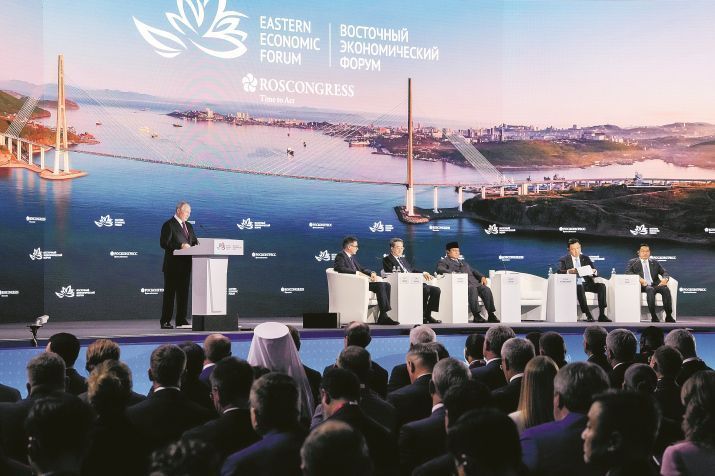
Russia is beginning to implement an updated Strategy for the Development of the Far East, running through 2036. Russian President Vladimir Putin announced this in his address to the plenary session of the 11th Eastern Economic Forum (EEF).
THE DIRECTION OF TRAVEL
A solid foundation for the accelerated growth of the Far East has been laid and it is time to move on to the next stage, the head of state said. He named maintaining a high pace of development and launching new investment cycles in the region as the key task.
The president singled out three main areas for investment. The first is industrial, infrastructure, tourism, creative and other projects geared to increasing the capacity of Russia’s domestic market and to growing demand in the Asian region. The second is innovative companies, the development of infrastructure for the digital platform economy and the introduction of promising technologies. As the third basic priority Vladimir Putin named investment in human capital. He noted in particular the need to develop population centers on the basis of carefully considered master plans. Such plans have now been drawn up for 22 anchor settlements in the Far East and 15 in the Arctic. By 2030 no fewer than 200 master plans are to be prepared across the country, the president noted. He expressed the hope that the law on master planning would be passed by both chambers of the Federal Assembly before the end of this year.
Vladimir Putin announced the introduction, from January 1, 2027, of a single preferential regime for business throughout the Far East and the Arctic.
BUILDING ON INFRASTRUCTURE
Vladimir Putin named modern, reliable infrastructure as the basis of the new spatial model for the Far East and the Arctic. “We will expand the capacity of logistics hubs and transport links,” he said. As examples he mentioned the expansion of the Eastern Operating Domain and the modernization of logistics facilities.
Vladimir Putin named the Comprehensive Plan for the Development of the Arctic and the Trans-Arctic Transport Corridor (TATC) through 2050 as the most important initiative, one intended to “stitch together the logistics space of the Far Eastern and Arctic regions.”
The TATC, whose end points are St. Petersburg and Vladivostok, develops the idea of the Northern Sea Route, which forms part of it. As the Russian president stressed, the TATC is intended to provide flexibility and security for international supplies and to open up new opportunities for transit and coastal shipping, ensuring uninterrupted northern supply deliveries to Russia’s Arctic regions.
“We have set ourselves the goal of making navigation along the route year-round. We also plan to integrate Arctic sea terminals with railways and inland waterways so that cargo flows from Central Russia, the Urals and Siberia are gradually brought in and imported goods are delivered. We expect shipments along the Trans-Arctic Corridor to reach at least 70 million tons a year by the end of this decade,” Vladimir Putin said.
He instructed that all the regional capitals of the Far East be connected to a quantum communications network by 2030. As the head of state noted, the security and high speed of information transfer is a key issue for the development of the digital platform economy, including the introduction of artificial intelligence tools and the construction of a network of data processing and storage centers. Plans to site such centers in the Arctic and the Far East exist and are already being carried out, Vladimir Putin stressed.
The president called on the government to consider introducing a special legal regime in the Far East that would allow new technologies to be tested quickly and without bureaucratic delay. This would create the conditions for attracting Russian and foreign scientists to the region’s research centers.
The Far East is already serving as a proving ground for promising technologies. Under a special project, for example, cargo delivery by drone will be put to the test. Its participants will be Russia’s Ministry of Transport, GLONASS and Chinese companies.
GLOBAL EXPERIENCE
Foreign participants in the plenary session also set out their vision of development. Indonesian President Prabowo Subianto noted that bilateral trade with Russia reached $5 billion in 2025 and called for a “bold target” — doubling that figure.
Mongolian Prime Minister Nyam-Osoryn Uchral said Mongolia has set itself the goal of becoming a major transport and logistics, energy, trade and investment hub for the region. In his words, Russia and Mongolia “have considerable scope for mutually beneficial joint projects in such fields as energy, mining, rail transport, transport and logistics, agriculture, environmental protection and industry.”
Ding Xuexiang, Vice Premier of China’s State Council, stressed the importance of making use of the geographical advantages and natural wealth of the Russian Far East and called for a focus on significant projects in priority areas. Among these he put energy and transport initiatives first.
Myanmar Vice President Nyo Saw singled out his country’s role as a bridge between the countries of South and Southeast Asia and China. Myanmar is actively developing its transport infrastructure today and needs foreign partners. Talks are under way with Russia, in particular, on taking part in the construction of the deepwater port of Dawei, Nyo Saw said.
Dmitry Koptev
- April 2026
- September 2026
- August 2026
- July 2026
- June 2026
- May 2026
- February 2026
- January 2026
- December 2025
- November 2025
- October 2025
- September 2025
- August 2025
- July 2025
- June 2025
- aprel-2025
- March 2025
- February 2025
- January 2025
- December 2024
- November 2024
- September 2024
- August 2024
- July 2024
- June 2024
- May 2024
- April 2024
- March 2024
- February 2024
- January 2024
- December 2023
- November 2023
- October 2023
- September 2023
- August 2023
- July 2023
- June 2023
- May 2023
- April 2023
- March 2023
- February 2023
- January 2023
- December 2022
- November 2022
- October 2022
- September 2022
- August 2022
- July 2022
- June 2022
- May 2022
- April 2022
- March 2022
- February 2022
- January 2022
- December 2021
 Read next content