
In 1898, halfway to Ibadan, the line under construction reached Abeokuta — a city on the Ogun River, an administrative center whose population was growing rapidly through the descendants of freed slaves who had resettled from Sierra Leone. This marked the beginning of the country's railway transport.

The old railway station in the city of Abeokuta, 25 September 2019. (Source: Wikimedia Commons. Photograph: Agbebiyi Adekunle)
The Lagos–Ibadan line, 192 km long (of “Cape” gauge — 3 ft 6 in, or 1,067 mm), was opened in full on 4 March 1901. However, owing to a strategic error connected with siting the railway's terminus at Iddo, Lagos was left without any public transport to link it with the railway station.
That same year saw the completion of the Gilbert Carter Bridge (governor of the colony of Lagos in 1891–1898), begun in 1896, which connected the city of Lagos, situated on an island, with the mainland. And soon afterward the colonial administration decided to lay a steam tramway line across the bridge, with a gauge of 2 ft 6 in (762 mm). Its opening took place on 23 May 1902.
The tramway line was single-track with 7 passing loops, was intended for freight and passenger traffic, had a length of 4.4 km (not counting sidings), and ran partly along streets and partly along the verges of the roads. The end-to-end journey time from Iddo station to Kokomaiko station was 21 minutes.
Initially, traction was provided by three locomotives of a unique type, designed to take account of the minimum curve radii of 24 m and the 5 t weight limit in force on the Carter Bridge. The locomotives were designed by the Crown Agents for the Colonies agency and built by Hunslet Engine Co. Ltd. of Leeds. In 1910, after the network had been expanded, two further locomotives of the same design were purchased.
Articulated steam locomotive No. 101 of the Lagos Government Railway, built by Hunslet Engine Company in 1901, one of the three locomotives of the first batch.

(Source: Francis Jaekel. The History of the Nigerian Railway. Ibadan: Spectrum Books, for Diamond Bank, 1997, Vol. I.)
The rolling stock of the Lagos steam tramway consisted of 10 passenger and about 20 freight two-axle cars, built by the Manchester firm Ashbury Railway Carriage & Wagon Company. Time passed, and after a four-year interruption the Lagos–Ibadan railway was extended farther north. In 1909 it was carried as far as Jebba (483 km), situated on the southern bank of the Niger River, thus
connecting two separate British colonies — the Lagos Protectorate and the Protectorate of Northern Nigeria. Meanwhile, the government of Northern Nigeria decided to connect its two most important cities, Kano and Zaria, with the sea. To this end, construction began on a railway from Baro, where the Niger becomes navigable, via the cities of Minna, Kaduna, and Zaria to Kano. This line was placed in service on 1 January 1912.
On the same day, traffic opened from Jebba to Minna, which became a junction station (the Niger was crossed by means of a railway ferry). And as early as 3 October 1912 the administrations of the Lagos Government Railway and the Baro–Kano railway merged into the Government Department of Railways, which now had 1,050 km of lines on its books. Interestingly, the amalgamation of the railways anticipated the administrative amalgamation of Southern and Northern Nigeria into the territory “Colony and Protectorate of Nigeria,” which took place in 1914.

The railway bridges over the Niger River near Jebba, placed in service in 1916, on a postage stamp of Colonial Nigeria, 1953. (Source: Wikimedia Commons)
In July 1914 the 213 km Jos–Zaria line was placed in service, intended mainly for carrying tin from the mines located on the Jos Plateau. The gauge was 762 mm, so at Zaria station the ore was transhipped into Cape-gauge cars.
In 1909 the British mining engineer Albert Kitson first discovered deposits of coal near the city of Enugu. To carry out this mineral, the 240 km Eastern railway line Enugu–Port Harcourt was built in 1915–1916. In 1922 the Eastern line was extended northward and in 1924 carried as far as Makurdi, on the left bank of the Benue River — the largest tributary of the Niger. At the same time, construction began on a railway south from Kaduna, and in 1927 the two lines met near Kafanchan, 717 km north of Port Harcourt, creating a single Nigerian network (a ferry service was arranged across the Benue). That same year the Kafanchan–Jos branch was built, making it possible to carry tin out of Jos directly, bypassing the 762 mm gauge line.
Meanwhile, in 1930 the Lagos–Kano trunk line was extended by 229 km to Nguru, and a year earlier the 235 km Zaria–Gusau branch was placed in service (later extended to Kaura Namoda).
A railway landscape of Colonial Nigeria. (Source: Wikimedia Commons; from the photograph collection of the National Archives of the United Kingdom)
Although the Great Depression of the 1930s affected Nigeria far less than it did the mother country itself — Britain and the other countries of the West — new railway projects in the country were curtailed. The last significant construction of the colonial period to be realized was the building of a combined bridge over the Benue River, 800 m long, at that time one of the largest in Africa, placed in service in 1932. The planned Nguru–Maiduguri (368 km) and Gusau–Sokoto railways were never built.
The following two decades and more are of no particular note in the history of Nigeria's railways. However, the growth of national self-awareness after the Second World War, and the increase in Nigeria's degree of autonomy brought about by this factor (constitutional reforms and the active involvement of “natives” in governing the colony), was also reflected in the railways. In 1955 the Government Department of Railways was reorganized into the Nigerian Railway Corporation (NRC).
That same year, the country's railway network received its first diesel locomotives. These were locomotives built by The English Electric Co. Ltd., which arrived in Nigeria in a quantity of 10 (Nos. 1001–1010). They were all assigned to the Zaria depot and intended to serve the Zaria–Kano section, where there had originally been problems with the water supply.

NRC diesel locomotive No. 1007, with an output of 750 hp, at the Zaria depot. (Source: www.topforge.co.uk/Photographs/NRC.htm. Archived at archive.org)
It is a remarkable fact that during the visit of the English Queen Elizabeth II to Nigeria in 1956, the train carrying the monarch from Lagos to Ibadan was hauled by a pair of diesel locomotives, Nos. 1008 and 1009. They were later returned to their usual section of operation.
In 1957 the Cape gauge became the only one on the country's railway network. This came about owing to the closure of the little-used Jos–Zaria line of 762 mm gauge. The main line of the Lagos steam tramway, however, had ceased to exist long before this event — back in 1914 (the locomotives, which had proved reliable, did not even exhaust their service life). And the so-called “sanitary line” of the Lagos tramway, opened in 1906 and intended for carrying away collected waste (“night soil”) for its subsequent processing into fertilizer, closed in 1933.
In the period from 1958 to 1964, a grand project was carried out in stages to extend the Eastern Railway from Kuru station (between Kafanchan and Jos) to the city of Maiduguri, with a total length of 637 km. The construction was completed after Nigeria had already gained independence, which was proclaimed on 1 October 1960. By this time the NRC network had received a further 29 diesel locomotives and 1,061 freight cars.

The highest point of the NRC railways — 1,318 m above sea level (the Jos Plateau, the Kuru–Bauchi section, opened on 16 October 1961).
(Source: Francis Jaekel. The History of the Nigerian Railway. Ibadan: Spectrum Books, for Diamond Bank, 1997)
Thus, the operating length of the Nigerian railway network by the mid-1960s was 3,480 km. The electric train staff system with semaphores was used everywhere, supplemented on the Lagos–Ibadan and Port Harcourt–Enugu sections by telephone dispatching communication. The overwhelming volume of traffic was still handled by steam traction.
The turning point in the renewal of the traction rolling stock came in the 1970s. By the middle of the decade fewer than a hundred steam locomotives remained on the network, and the last of them were struck off the inventory in 1982–83. Not only diesel locomotives from British suppliers were purchased, but also locomotives built in the United States, Canada, West Germany, and Japan.
NRC diesel locomotive No. 1714 built by the Canadian company Montreal Locomotive Works, Lagos, 1974. (Source: Wikimedia Commons)
At the same time, the country's railway network stagnated: no new lines had been built since 1964, and 80% of the existing track was in need of repair. This was largely due to the extremely unstable political situation in the country (the civil war of 1967–1970 and numerous military coups). But in 1987, under President Ibrahim Babangida, construction began on the country's first railway of 1,435 mm gauge. The 326 km Warri–Itakpe line was to connect the Itakpe Hill iron-ore deposit and the seaport of Warri with the full-cycle metallurgical works at Ajaokuta, built in 1981–1994 with the assistance of the Soviet Union (and later the Russian Federation). However, after 254 km of the line had been built, construction was abandoned and resumed only in 1999.
At the turn of the 20th and 21st centuries, the situation on Nigeria's railways continued to deteriorate. After a bridge collapsed in 2002, the Zaria–Gusau line was closed. Compared with 1964, the number of passengers carried in 2003 had fallen sevenfold, and of freight (in 2005) almost fiftyfold! The extreme dilapidation of the infrastructure and rolling stock could not be remedied even by the purchase in 1996–1999 of 50 diesel locomotives built by the Chinese company CRRC Dalian Co., Ltd. From 1993 the delivery of new cars to the network ceased, although as of 2008 some cars in the NRC fleet had reached the age of 60.
In 2005 passenger services from Lagos were reduced to four departures a week, of which two trains ran to Kano, one to Jos, and one to Maiduguri; four trains a week also departed from Port Harcourt, two of which ran to Kano, one to Jos, and one to Maiduguri.

A carriage of the Kano–Lagos train. (Source: hausa.premiumtimesng.com)
From 2009 the implementation of a government program to revive Nigeria's railways began. By this time the only operating railway line in the country was the section between Lagos and Kano. Passenger trains needed 31 hours to cover the whole route at an average speed of 45 km/h. The Eastern line from Port Harcourt to Maiduguri was overhauled in 2011–2014 at a cost of US$427 million by the companies Lingo Nigeria, Eser West Africa, and China Gezhouba Group, after which train services resumed on it. After a long interruption, the NRC once again began to repair and purchase rolling stock.
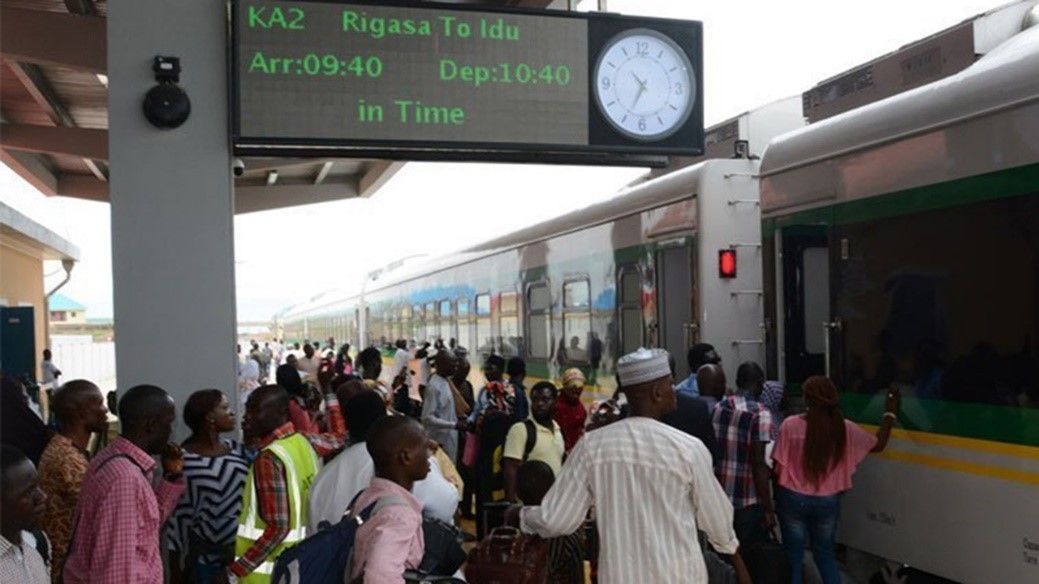
In February 2011 the Chinese company China Civil Engineering Construction Corporation (CCECC) began construction of the standard-gauge Abuja–Kaduna railway line, which was opened on 26 July 2016. The total cost of the project was US$870 million. The journey along this 186.5 km line, which begins at Idu station 20 km west of the center of Abuja (the country's capital since 1991), takes just two hours. Interestingly, the popularity of rail travel on this route is due, among other things, to the fact that it offers a safer alternative to the car for the residents of both cities — the parallel highway having become a favorite haunt of robbers.

Boarding the Kaduna–Idu (Abuja) train. (Source: Pinterest.com)
Meanwhile, on 29 September 2020, the Warri–Itakpe railway, whose construction had continued with interruptions for 33 years, was at last officially opened. The virtual ceremony, at the height of the COVID-19 pandemic, was conducted by President Muhammadu Buhari. Passenger trains began running on the line in October of that year, and freight trains in April 2021. At present, Nigeria's railway network consists of 3,505 km of Cape-gauge lines and 669 km of standard-gauge lines. This figure does not include the 42.5 km of the Abuja Light Rail, placed in service in July 2018, or the 54 km of the Lagos Rail Mass Transit, which entered service in 2023–2024. There are no electrified sections, with the exception of the Blue Line in Lagos (27 km), which uses a contact rail (750 V).

An Abuja Light Rail train at the Abuja railway station, 10 June 2019. (Source: Wikimedia Commons)
Since 2021 construction has been underway of Nigeria's first railway of international significance. This will be a 1,435 mm gauge line, 284 km long, which will connect Kano with the city of Maradi in the Republic of Niger. Completion of the construction is planned for 2026.
Despite the successes achieved over the past decade and a half in developing the railways, for a country that ranks sixth in the world by population and first in Africa by GDP, the current situation with rail transport can by no means be regarded as satisfactory. In the longer term, the Nigerian authorities plan to unite all the isolated sections of 1,435 mm gauge into a single railway network and to continue its expansion into other regions of the country.
A joint project of 1520International and the Institute for Economics and Transport Development (IETD)
 Read next content