

A model train presented by Queen Victoria of England to King Mongkut of Siam (Rama IV). (Source: www.tour-bangkok-legacies.com)
The second project envisaged crossing the Isthmus of Kra, the narrowest point of the Malay Peninsula, by railway, since building a canal across the isthmus proved technically unfeasible. However, this railway too — despite the Siamese government's consent in 1859 — was never built, owing to the British reluctance to create competition for Singapore, which was under British control.
In the 1880s the Siamese government granted various private consortia concessions to build railways. But these consortia were, for the most part, speculative companies that undertook no actual construction. In the end, the first railway in Siam came about through the private initiative of the Paknam company, founded by the British navigator Alfred John Loftus and the Danish shipowner Andreas du Plessis de Richelieu (a descendant of the elder sister of the famous Cardinal Richelieu). Construction began on 10 July 1891, and on 11 April 1893 King Chulalongkorn (Rama V; reigned 1868–1910) ceremonially opened the 21 km Bangkok–Samut Prakan (Paknam port) railway (1,000 mm gauge). Earlier still, on 1 January 1893, the Bangkok electric tramway had opened — the first in Asia.
By this time, in 1890, the Royal Railway Department (RRD) had been established within the Ministry of Public Works. The head of the RRD was the eminent German engineer Dr. Karl Bethge (1847–1900), who had earlier served as the representative of the Krupp firm in China and, from November 1888, as King Chulalongkorn's adviser on transport matters. Of the plans for forming Siam's railway network, drawn up in 1888 by the British military engineer Sir Andrew Clarke, priority was given to building a line from Bangkok via Saraburi to Nakhon Ratchasima.
Construction of the North-Eastern Railway, with a gauge of 1,435 mm, began on 9 March 1892 and was officially completed on 21 December 1900. Sadly, Bethge did not live to see this event: shortly before, he had died of cholera in Bangkok.

King Rama V (standing) and Queen Saovabha Phongsri (seated) inaugurating the North-Eastern Railway. (Source: Wikimedia Commons)
Before the railway opened, the journey between Bangkok and Nakhon Ratchasima (also known as Khorat) took five days, whereas by train the travel time came to just six hours. The opening date of its first section, from Bangkok to Ayutthaya — 26 March 1897 — is today the official birthday of the State Railway of Thailand.
It is worth noting that Karl Bethge's successors as director-general of the RRD were also Germans, his former colleagues: Hermann Gehrz in 1900–1904, and, from 1904, Luis Weiler. This accounted for the predominance in the Siam of that time of steam locomotives from the Henschel and Krupp firms. Interestingly, Luis Weiler had lived for several years in Russia, where his father, Karl Weiler, worked for many years as an engineer and was even a member of the management of the Kiev–Brest Railway. The extensive correspondence carried on over many years between father and son, who served as each other's technical experts, allows one to find in the history of Thailand's railways not only a German but also a Russian trace.

The flag of the Royal State Railways of Siam in 1898. (Source: Wikimedia Commons)
The next project to be realized in Siam was the Northern Railway. The point is that the construction of the Southern and Eastern Railways was at that time complicated by geopolitical factors: to the south and west of Siam lay British colonies, and to the east, French possessions. And when a revolt broke out in northern Thailand, the state directed its resources to building the Bangkok–Chiang Mai railway, which began in 1898 from the junction station of Ban Phachi, located at the 90th kilometer of the North-Eastern Railway then under construction.
The first 44 km section, to Lopburi, was opened in 1901. Then, owing to financial difficulties, the government borrowed a total of 4 million pounds sterling from British and French banks, which accelerated the pace of construction, and by 1909 the line had reached the city of Uttaradit. The total length of the country's state railways had by this time reached 925 km. In connection with the start of construction of the Southern Railway, the further extension of the Northern line was suspended, and some of the engineers were transferred to the southern construction site.
In 1912 construction resumed, but a few years later it was again suspended because of the First World War: on 22 July 1917 Siam, which had hitherto maintained its neutrality, declared war on Germany and Austria-Hungary. As a result, Luis Weiler was removed from his post and detained, and his place was taken by the Thai prince Kamphaengphet. The subsequent fate of the former head of Siam's railways was tragic: released early because of illness, he died on 16 January 1918 aboard ship on his way home to Germany.
In the end, although the Northern Railway had by then reached Lampang, the 109 km section to Chiang Mai opened only in 1922.

The railway station in Chiang Mai, 17 April 2017. (Source: Wikimedia Commons. Photograph: Uwe Aranas)
The start of construction of the Southern Railway, as far as Phetchaburi, dates to April 1900. Unlike the previously created railway network east of the Chao Phraya (Menam) River, which had been built to the standard gauge, in this case the 1,000 mm gauge was used. The aim of this choice was to reduce construction costs and to facilitate a prospective link with Burma and Malaya, which also used the meter gauge. In addition, account was taken of the fact that the Southern Railway was cut off from the rest of the network by the absence of a bridge over the Chao Phraya. For this reason, the trains of this railway did not depart from Bangkok's main station, Hua Lamphong, but had their own terminus at Thonburi. The station building was designed by the German architect Karl Siegfried Döhring in the “brick expressionism” style.
Construction of the Southern Railway was divided into three sections, work on which began simultaneously. The entire line, Siam's first international railway, opened in 1921.

A steam locomotive built by the North British Locomotive Co. (Glasgow, 1919), which worked on the Southern Railway, on permanent display at Chumphon. (Source: www.internationalsteam.co.uk. Photograph: Michael Pass)
As for the Eastern Railway, designed back in 1901–1906, thanks to King Vajiravudh (Rama VI, 1910–1925) the project was, after the end of the First World War, “taken off the shelf,” and in 1926 a 194 km line was opened, with a meter gauge, from Bangkok to Aranyaprathet on the border with French Indochina.
The same period saw the implementation of the project to unify the gauge on Siam's railways. It was decided that the Northern and North-Eastern Railways (1,435 mm gauge) should be converted to the 1,000 mm gauge, in order to facilitate possible international traffic, since all the neighboring countries had adopted the meter gauge. The re-gauging began in 1920 and took ten years. Also, in 1922–1927 the Rama VI Bridge was built in Bangkok, which united the railway networks of the left and right banks of the Chao Phraya River into a single whole.

The Rama VI Bridge (view from the eastern bank), 5 January 2008. (Source: Wikimedia Commons. Photograph: Erzengel)
In 1929 the RRD proposed a plan to electrify the Bangkok–Ban Phachi section, which carried the heaviest traffic on the network. However, this project was rejected by the government owing to distrust of the new form of traction, despite the fact that the private Bangkok–Paknam port railway had been electrified as early as 1926. The RRD did, however, manage to adopt diesel locomotives. In 1928 two diesel locomotives with mechanical transmission were placed in service, and a further 13 arrived on the country's railway network in the early 1930s.
In 1932 a revolution took place in Siam, which led to the replacement of the king's absolute power by a constitutional monarchy. Changes came in all spheres of the country's life. The RRD, which had previously held powers equivalent to those of a ministry, was reduced to an ordinary department. The People's Party government that came to power made road construction a priority, for which purpose a national 18-year plan was drawn up in 1936. After this, the development of the railways stalled (their length at that time was 3,100 km).
In 1939 the country acquired a new name, Thailand, and the following year invaded French Indochina and occupied Cambodia. On the annexed territory, work began to complete the Aranyaprathet–Phnom Penh railway line, which the French had not managed to finish. It fell, however, to Japan — with which Thailand concluded a military alliance treaty — to complete the construction. On 22 December 1941 the first train set off along the Phnom Penh–Bangkok route.
Having effectively occupied Thailand, the Japanese made it a springboard for their offensive against Malaya and Burma. But whereas rail communication with Malaya had been established in 1921, the line to Burma had yet to be built. The construction of the 415 km Thailand–Burma Railway was carried out from June 1942 to October 1943, became the deadliest construction project in modern history, and has been recognized as a war crime.
In building the “Death Railway,” the Japanese army used the labor of some 180,000 forcibly mobilized inhabitants of Southeast Asia and 60,000 prisoners of war of the anti-Hitler coalition. Roughly 90,000 Asian laborers and 16,000 prisoners of war died of hunger, disease, and ill-treatment — that is, almost one in every two of those who built it. The last of the survivors, the British veteran Jack Jennings, died on 19 January 2024 in his 105th year.

The construction of the “Death Railway.” (Source: www.abc.net.au)
Because Thailand's railways formed part of the Japanese military supply system, they became one of the most important targets of Allied bombing. As early as 1944 the railway network was severely damaged, and its main depots and bridges destroyed, including the Rama VI Bridge. By April 1945 traffic on the Thailand–Burma Railway had also ceased.
At the end of the Second World War, of Thailand's 186 steam locomotives only 3 were in working order. A similar situation was observed with diesel locomotives and carriages. As part of the restoration of the railway system, however, in 1945–1950 the country purchased 68 steam locomotives in the United States and 174 in Japan. Also purchased from Japan were 200 passenger and 1,000 covered freight cars, while from Switzerland came 7 diesel-electric locomotives ordered before the war. The World Bank granted a loan of US$25.3 million to repair the infrastructure.
On 1 July 1951 the RRD was reorganized into the State Railway of Thailand (SRT). By 1960 the SRT's rolling-stock fleet, thanks to foreign aid and loans, had grown to 8,391 cars, compared with about 4,000 in the prewar period.
In 1955 work began on the network to replace the old 50-pound rails (24.8 kg/m) with heavier ones, and by 1960 60-pound (29.8 kg/m) and 70-pound (34.7 kg/m) rails lay on 45% of the railway network.
Moreover, back in 1949 a 10-year plan for new railway construction had been approved. However, owing to a shortage of budget funds, in 1958 all construction work was suspended. In the end, only two lines were built in full (both on the North-Eastern Railway): Kaeng Khoi–Bua Yai and Udon Thani–Nong Khai. The United States was especially interested in the construction of the latter, wishing during the Cold War to obtain convenient access to Laos. Branches were also built on the Southern Railway: Surat Thani–Khiri Rat Nikhom and Nong Pladuk–Suphan Buri (the latter being part of a strategic bypass of Bangkok that was never realized). As for international traffic, through rail communication with Cambodia ceased after its return to France at the end of the war. By 1 July 1958 the Thailand–Burma Railway had been restored along a 130 km domestic section, while the northern sections on the border with Burma were finally swallowed up by the jungle.

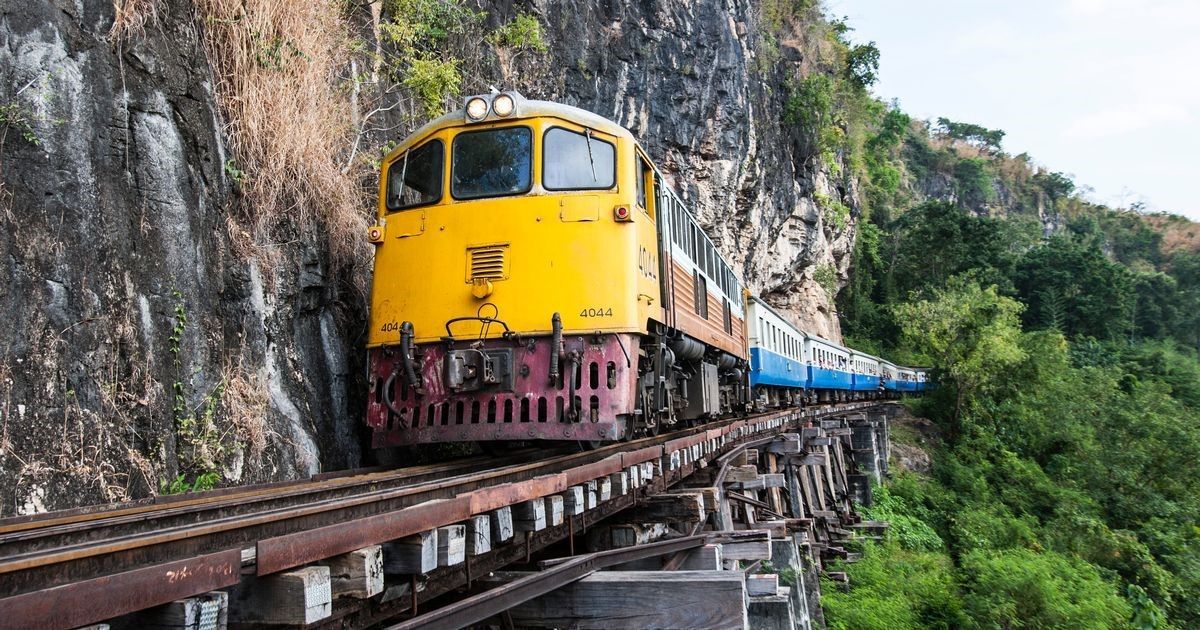
A passenger train on the restored section of the Thailand–Burma Railway (the trestle by the River Kwai), 2022. (Source: www.irishmirror.ie. Photograph: Getty Images)
From the late 1950s, a gradual decline of the railways set in in Thailand. Until then, the state of the country's roads — despite the course toward motorization adopted after the Siamese revolution — had been poor, especially in areas remote from Bangkok, and the motor vehicle competed only with difficulty against rail transport. In 1958, however, the first motorway was opened, and from 1963 motorway construction accelerated extraordinarily. From that time on, Thailand's railway network scarcely expanded, growing by about 360 km between 1960 and 1990.
At the same time, on 1 January 1960 the historic Paknam railway line (the country's only electrified railway), which was impeding the development of Bangkok's street network, was closed altogether, and in 1968 the Bangkok tramway network followed suit.

An electric train at Paknam station, 1959. (Source: Wikimedia Commons. Photograph: Wally Higgins)
In 1961 the SRT, owing to a shortage of timber (steam locomotives ran on wood fuel), decided to switch entirely to diesel traction by 1980. Thus the fleet of diesel locomotives grew from 64 in 1960 to 244 in 1975, while the number of steam locomotives fell sharply — from 306 in 1960 to just 7 in 1985 (some of them preserved for tourist trips).
In order to compete with road transport on intercity passenger routes, the SRT launched a night-train service. The first of these was the Bangkok–Phitsanulok train (1961). And in 1965 the express train between Bangkok (Thonburi station) and the town of Sungai Kolok on the Malaysian border switched to a night schedule.
The infrastructure was systematically reconstructed: from 1966 the replacement of 60- and 70-pound rails with 80-pound (39.7 kg/m) ones began, and then, in the 1990s, with 100-pound (49.6 kg/m) rails.
In the 1990s the modernization of Thailand's railway transport began, with the introduction of high-speed electric-traction transit systems in Bangkok and its surroundings. For this purpose, back in 1992, the Mass Rapid Transit Authority of Thailand (MRTA) was created.
The first such system was the elevated BTS metro, owned by the Bangkok Metropolitan Administration (BMA). It began operating in 1999. The BTS has a 1,435 mm gauge (which had been absent from the country for the preceding 70 years), is electrified by a third rail (750 V), and comprises 70 km of lines. Similar technical parameters (except for two monorail lines) are shared by the MRTA-owned Bangkok Metro, opened in 2004.
And finally, in 2010 the SRT opened the 28 km ARL railway line between the center of Bangkok and Suvarnabhumi Airport. It, too, has a 1,435 mm gauge, but is electrified with 25 kV AC.

The “three-level” Phaya Thai station in Bangkok, serving the BTS, the ARL, and the SRT's Eastern railway line, 19 July 2023. (Source: Wikimedia Commons)
Despite this, outside the Bangkok agglomeration the construction of meter-gauge railways (whose total operating length is 4,310 km) is still considered to have good prospects. Thus, in 2009 traffic opened on a 6 km section linking the border stations of Thailand (Nong Khai) and Laos (Thanaleng) across the Mekong River via the Friendship Bridge. And in 2022–2023 construction began on two new railway lines with a total length of 681 km, planned for completion in 2028.
In addition, since 2016 the “Double-Track Railway” project has been successfully underway, providing for the construction of 3,157 km of second tracks. Also, in the vicinity of the capital, the existing meter-gauge lines are being electrified for commuter service (the first section opened in 2021).
The future of long-distance passenger transport in Thailand, however, is linked with high-speed traffic on the 1,435 mm gauge, for which, in December 2017, construction began in the country on the first, 873 km, Bangkok–Nakhon Ratchasima section of the future high-speed rail network.
A joint project of 1520International and the Institute for Economics and Transport Development (IETD)
 Read next content