
The first section of railway was opened in 1854 in Egypt — a vassal state and autonomous part of the Ottoman Empire — between Alexandria and Kafr el-Zayat, and in 1856 the line reached Cairo. (We have already given a detailed account of the history of Egypt's railways earlier: “The Establishment and Development of Railways in Egypt (1854–Present)”)
The construction of the first railway line within the borders of present-day Turkey began on 22 September 1856, undertaken by the British company Ottoman Railway Company (ORC). This was the Izmir–Aydın line (1,435 mm gauge), the first section of which, between the stations of Alsancak, Gaziemir, and Seydiköy, was opened on 30 October 1858.

The railway station in Izmir (an old postcard devoted to the Izmir–Aydın railway). (Source: au.pinterest.com)
The entire 130 km line was opened in 1860 and was intended to carry minerals and fruit (above all figs) from the Aydın plain to the port of Izmir for export. Further construction of the railway continued right up to 1912, by which time the length of its lines and branches had exceeded 600 km.
The second railway to open was the Izmir–Turgutlu line, built by the company Smyrna Cassaba & Prolongations, also from Britain. Its construction began in 1864. The section to Manisa was opened on 10 October 1865, and that to Kasaba on 10 January 1866. The company then built a branch to Bornova (diverging from the main line at Halkapınar), which opened on 25 October 1866. As with the Izmir–Aydın line, the development of the railway continued over several decades, and by 1912 its total length had reached 700 km.

A railway bridge over the Gediz River near Manisa on the Manisa–Soma section, 1890. (Source: www.trainsofturkey.com, photographers Sebah & Joaillier. From the collection of J. P. Charrey)
As for the capital of the Ottoman Empire — Constantinople (Istanbul from 1930) — it obtained rail communication only after the opening, in 1871, of the 15 km Yenikapı–Florya section. In 1872–1873 the 288 km “European Railway” reached the Greek border, becoming part of the famous “Oriental Railway” (Chemins de fer Orientaux). On 12 August 1888 train services opened on the Constantinople–Vienna route. And soon afterward, on 1 June 1889, one of the most famous trains in history, the Orient Express, made its first run from Paris to Constantinople. This train was operated by the international hotel and logistics company Compagnie Internationale des Wagons-Lits (CIWL), headed by the Belgian Georges Nagelmackers. From 3 November 1890 the terminus of the Orient Express and of other passenger trains in Constantinople became the new Sirkeci railway station.

A poster devoted to the Oriental Railway, 1898. (Source: Wikimedia Commons. Artist: B. Gewis)
With interruptions during the First and Second World Wars, the Orient Express remained in service right up to 2009, when it was finally removed from the timetable. This train, however, entered forever not only the history of railways but also the shared culture of mankind. This was in large measure due to the famous novel by the English writer Agatha Christie, Murder on the Orient Express (she herself travelled by this train on more than one occasion), written in 1933.
In Asian Turkey the development of the railways proceeded very slowly. The “Anatolian Railway” Haydarpaşa (the terminus in the Asian part of Constantinople)–Izmit, 93 km long, built in 1871–1873, was sold in 1877 to Deutsche Bank, with the right to continue the line to Angora (Ankara from 1923) and the privilege of obtaining the concession for the Baghdad Railway. In 1888–1890 the Germans built the 486 km Izmit–Eskisehir–Angora section, and in 1893–1896 the Eskisehir–Konya section (445 km).
And only in 1899, after the visit of the German Kaiser Wilhelm II to the Ottoman Empire, did the head of Deutsche Bank, Georg von Siemens, sign a preliminary agreement on the concession for the construction and operation of the main line of the Baghdad Railway — from Konya via Baghdad to the Persian Gulf. For this purpose a purely German company with a French name was first created, Société de Chemins de Fer Ottomans d’Anatolie, and, as a result of the Franco-German agreement of 6 May 1899, French capital was admitted to a share in the construction.
In 1903 the concession for the Baghdad Railway was finally formalized. By 1912 the 291 km trunk section Konya–Ulukışla had been placed in service, along with the section Toprakkale–Iskenderun (59 km), isolated at the time. In 1911 construction began on a section (also isolated) toward Baghdad from Islahiye station, whose rails, by the start of the First World War, had been extended to Ras al-Ayn (now a Syrian town on the border with Turkey), reaching a length of 453 km.

A freight train in Turkey (the Baghdad Railway, no later than 1910). (Source: Wikimedia Commons. Photograph from the collection of the Library of Congress of the United States)
On the territory of modern Turkey the Baghdad Railway was completed by 9 October 1918, chiefly through the efforts of the railway troops of the German Empire. By bitter irony, among the first passengers on this section were the German employees of the Baghdad company, who were leaving the construction site ahead of the advancing Entente forces. As for the completion of the line along its entire length, the first through train from Istanbul to Baghdad set off only in July 1940.
After the defeat of the Ottoman Empire in the First World War and the conclusion of the Armistice of Mudros (30 October 1918), the Entente powers (France, Britain, Italy) set about seizing the country's most important military-strategic areas and bringing the railways under their control. But on 28 January 1920 the nationalist-patriots adopted in Constantinople the Declaration of Independence of Turkey, and after the expulsion of the occupiers from the country the Republic of Turkey was proclaimed on 29 October 1923, headed by Mustafa Kemal Atatürk.
Interestingly, during the Turkish War of Independence of 1919–1923, Mustafa Kemal used the building of the railway administration in Angora as his residence and headquarters, and today it serves as both the Atatürk House Museum and a railway museum.

Atatürk's railway carriage, which he used in 1935–1938. Atatürk's coffin was also conveyed in this same carriage from Izmit to Ankara on 19–20 November 1938. Railway Museum in Ankara, 2012. (Source: Wikimedia Commons)
Of the more than 8,000 km of railways built in the Ottoman Empire by 1922, 3,660 km of standard-gauge lines lay within the territory of Turkey, of which 1,378 km were in state ownership and the rest belonged to foreign investors (after 1 June 1927, when the state railway company TCDD (Türkiye Cumhuriyeti Devlet Demiryolları) began operating, all of them were nationalized in stages).
The government of the young republic devoted enormous attention to the railways and continued to expand their network through new railway projects: between 1923 and 1940 more than 3,000 km of new lines were built in Turkey. Railways were built to serve the coal and metallurgical industries, agriculture, and the ports; priority was given to lines in the central and eastern parts of the country, which in turn helped to secure the unity of the state.
The largest of these were the trunk lines Ankara–Irmak–Kayseri–Kalın–Sivas (602 km, opened in stages in 1927–1930); Samsun–Kalın (378 km, 1932); Fevzipaşa–Diyarbakır (the “Copper Line,” 504 km, 1935); Irmak–Filyos–Zonguldak (the “Coal Line,” 415 km, 1934–1937); and Sivas–Erzurum (the “Caucasus Line,” 548 km, 1936–1939). Several connecting lines were also built. However, steam traction was used exclusively, and the network remained almost entirely single-track (in 1934, 1.7 km of second main track was built in the Izmir railway junction). Automatic and semi-automatic block was likewise absent.

A static load test of the Göksu bridge near the town of Gölbaşı on the “Copper Line,” 1935. The reinforced-concrete bridge is 30 m high. The test is being conducted using two old German G8 steam locomotives. (Source: www.trainsofturkey.com. Photograph: Nohab)
During the Second World War, Turkey, which officially maintained its neutrality, nonetheless exported minerals to the “Third Reich.” In return, it managed to renew its rolling-stock fleet through deliveries of steam locomotives and carriages from Germany.
In the postwar years the emphasis in transport shifted to the development of roads. The volume of railway construction in Turkey fell sharply. One noteworthy event of this period was the development of commuter passenger services in the Istanbul railway junction, with the opening in 1949 of 72 km of second tracks. At first the services were operated by diesel trains, but on 4 December 1955 electric trains were launched to the west of the Bosphorus on the 28 km Sirkeci–Halkalı section. It is worth noting that this was the world's first use, in commuter traffic, of alternating current at 25 kV and 50 Hz.
The introduction of diesel traction also began on the network — in shunting service in 1953–1956 (44 locomotives), and in freight service in 1957–1958 (as yet in insignificant numbers).

A TCDD DE20002 diesel locomotive built by General Electric (one of the first five main-line diesel locomotives in Turkey) at the Ankara depot, 1969. (Source: Wikimedia Commons. Photograph from the collection of Phil Wormald)
By 1958 there were 7,625 km of standard-gauge railways in Turkey. In addition, on the 123 km Hudut (the border with the USSR)–Kars–Sarıkamış section, built in 1899 and 1914, the 1,524 mm gauge was preserved (the Kars region had belonged to Russia until 1918). There were also 122 km of public 750 mm gauge lines.
Meanwhile, measures to unify the gauge were actively carried out. Thus, in 1957 the narrow-gauge line between Horasan and Sarıkamış was replaced by a 1,435 mm gauge line, and in 1962 the re-gauging of the section up to the Soviet border from broad to standard gauge was completed.
The last major railway construction in the Republic of Turkey in the 20th century was the building of the Turkey–Iran trunk line. It consisted of two sections: a western one (Elazığ–Tatvan) 335 km long and an eastern one (Van–Kapıköy (the border with Iran)–Kotur) 193 km long. The middle part of the route included a train-ferry crossing over Lake Van, with a terminal at Tatvan on the western shore of the lake.
Construction of the western section was completed in 1964, and of the eastern section in 1971. The construction was difficult because of the complex terrain. The eastern section was to a large extent financed by the CENTO military bloc, which at that time included, besides Turkey, Iran, Pakistan, and Britain. The ferry crossing over Lake Van was regarded as a temporary solution, since it was intended to lay a railway along the southern shore of the lake. However, after the Islamic Revolution in Iran in 1979 and the dissolution of the CENTO bloc, the project to build the middle section lost its relevance and has not been realized to this day.

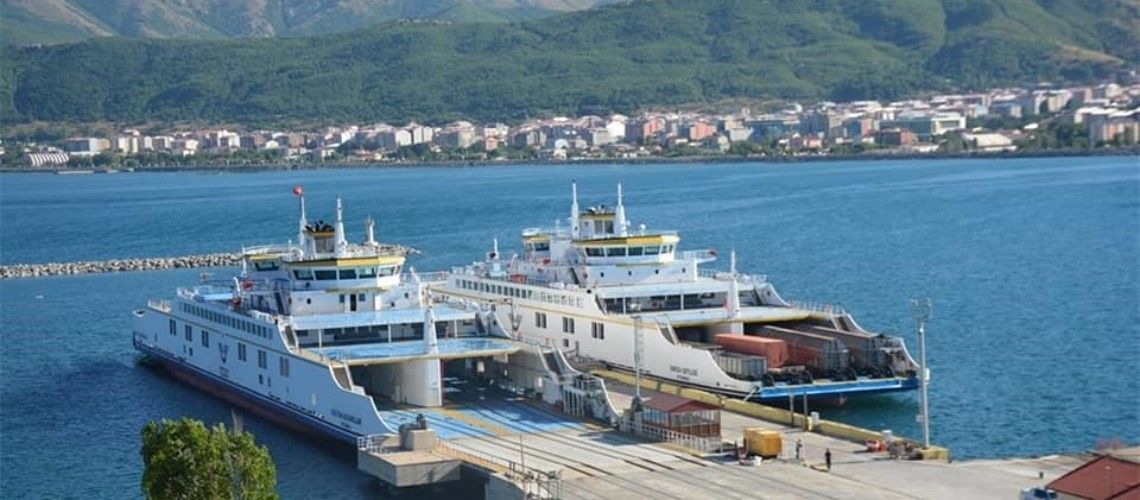
Ferries on Lake Van, 26 July 2018. (Source: railturkey.org. Photograph: Van Türkiye)
The last three decades of the 20th century and the beginning of the new century were years of decline for TCDD. The national transport plan “Interim Transport Planning for 1983–1993,” whose aim was to reduce the share of road transport from 72% to 36%, was cancelled in 1986 without being implemented. As a result, in 2002 only 4% of freight and 2% of passengers in the country were carried by rail.
Among the positive events of those years, one cannot fail to mention the organization of urban rail services with electric traction in Ankara (1972), as well as the electrification of the following railway lines:
1) in the Asian part of Turkey: Istanbul (Haydarpaşa)–Gebze–Arifiye–Eskisehir–Ankara (Sincan), with a branch to Adapazarı, commissioned in stages in 1969–1993, and Iskenderun–Divriği (1994);
2) in the European part of the country: Istanbul (Halkalı)–Edirne–the border with Bulgaria (1997).

A train hauled by electric locomotive No. E 52511 at Sirkeci station in Istanbul, 16 October 2007. Electric locomotives of this type were built from 1967 in Yugoslavia; Turkey leased them in 1998–2014 from the railways of Bosnia and Herzegovina. (Source: Wikimedia Commons)
In the period 1972–2003, new railway construction in Turkey almost ceased (over the course of more than 30 years, only 79 km of new lines were commissioned). The building of second tracks proceeded slowly. As of 2006, the TCDD network had only 393 km of second, third, and fourth main tracks (that is, 95% of the total length of the network still consisted of single-track sections).
In 2003, at the moment of the deepest decline of the national railways, TCDD and the Turkish Ministry of Transport concluded an agreement on the construction of a 533 km high-speed railway (HSR) between Ankara and Istanbul.
By this time, the average journey time by rail between Istanbul and Ankara for passengers was seven and a half hours, and moreover the trains were regularly late by anything from 30 minutes to 2 hours.
Construction of the first HSR section, from Esenkent to Eskisehir, 206 km long, began in 2004 and was completed on 23 April 2007. Meanwhile, TCDD signed an agreement with the leading Italian railway operator Trenitalia to lease an ETR 500 train for 4 months to test the system.
On 14 September 2007 an ETR 500 Y2 set established a speed record in Turkey, reaching 303 km/h. This test received wide coverage in the Turkish media. On 20 November 2007 the first TCDD HT65000 high-speed trains, purchased from the Spanish company CAF, arrived in Turkey.
On 13 March 2009 a ceremonial opening of the first stage of the HSR took place in Ankara, attended by President Abdullah Gül, Prime Minister Recep Tayyip Erdoğan, and Minister of Transport Binali Yıldırım. The head of the Russian delegation at the opening was the acting head of Roszheldor, V. Yu. Chepets.

A TCDD Taşımacılık HT65000 high-speed train at the Ankara railway station, 5 October 2018. (Source: Wikimedia Commons).
On the Esenkent–Polatlı–Eskisehir section the expresses ran at speeds of up to 250 km/h, while for the rest of the route they ran on the old line as ordinary trains. However, exactly one year later the next HSR section, Sincan–Esenkent (15 km), was opened, and in 2014 the high-speed sections Sapanca–Köseköy (24 km) and Eskisehir–Teşvikiye (131 km). Along the remainder of the line, HSR trains run over multi-track sections of the ordinary railway network at speeds of up to 160 km/h (Köseköy–Gebze), 140 km/h (Ankara–Sincan), and 120 km/h (Gebze–Istanbul). The last section, opened in stages in 2014 and 2019, is a component part of the famous Marmaray project, which linked the European and Asian parts of Istanbul by rail and includes the tunnel of the same name, 13.6 km long (including 1.4 km beneath the Bosphorus strait).

One of the Marmaray tunnels, 30 November 2024. (Source: Wikimedia Commons)
In 2010 one of the high-speed trains was converted into a laboratory train for testing new lines (this cost 14 million Turkish lira — about €7 million). Interestingly, this train was given a name of its own, “Piri Reis,” in honor of the famous Ottoman navigator and cartographer (c. 1470–1554).
The second HSR in Turkey was the Ankara–Konya line, branching off from the Ankara–Istanbul trunk line at Polatlı station (90 km from the Ankara terminal). This line, with an operating length of 211 km, was opened on 23 August 2011. It was later extended to the city of Karaman (the reconstructed Konya–Karaman section, 102 km long and designed for speeds of up to 200 km/h, entered service on 8 January 2022). And on 26 April 2023 the third HSR — Ankara–Sivas, 465 km long — was also opened, partly using the already existing network. A whole series of further high-speed and higher-speed lines is currently under active construction.
In present-day Turkey, however, considerable attention is also paid to expanding the ordinary railway network. In particular, the Kars–Akhalkalaki line (built in 2008–2017) linked Turkey with Georgia, and through it with Azerbaijan, becoming part of the modern “Silk Road.”

A container train passing the “zero kilometer” of the Kars–Akhalkalaki railway line, 2024. (Source: www.ensonhaber.com).
As of 2024, according to TCDD, the deployed length of all railway tracks in Turkey was 13,919 km, while the operating length of lines was 9,495 km (including 991 km of high-speed sections and 102 km of higher-speed sections); of these, 49.7% are electrified, and 20.2% have two or more main tracks.
In 2013 the Turkish government began reforming the railways. TCDD was split up, and from 2017 passenger and freight operations became part of a new company called TCDD Transport, while TCDD remained the operator of the tracks and infrastructure. This restructuring made it possible for other railway operators to run trains over TCDD's tracks for a fee and put an end to the 90-year state monopoly.
A joint project of 1520International and the Institute for Economics and Transport Development (IETD)
 Read next content