
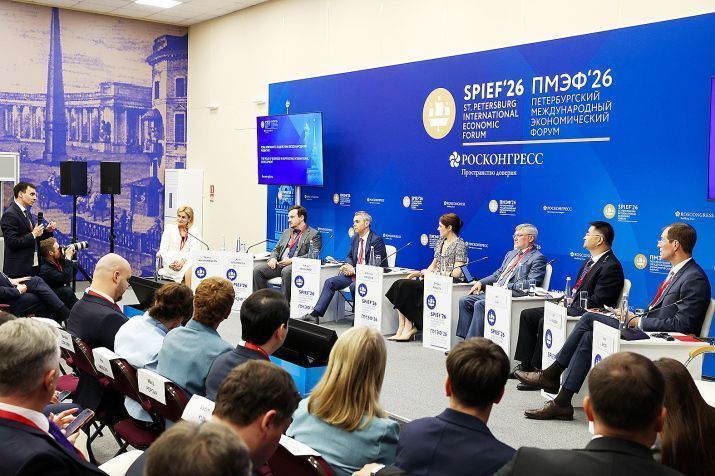
At the St. Petersburg International Economic Forum, business diplomacy was a major focus. Sergei Pavlov, First Deputy CEO of Russian Railways, spoke about the company’s work in this area.
THROUGH A BRICS LENS
On the transport front, the bloc's main achievements so far have been bringing the BRICS countries closer together and creating the conditions for trade between them to grow, Sergei Pavlov (third from the right in the photo) said during the session 'New Drivers of Business Partnership within BRICS.’
“Railways have become a vital link in global connectivity chains. With multimodal solutions, we deliver growing volumes of cargo quickly and safely to any country in the group,” said the RZD deputy CEO.
Pavlov noted that over the past five years alone, traffic on the RZD network to and from the BRICS countries has grown 2.5-fold and now accounts for almost 60% of the holding company’s international shipments.
Russian Railways’ cooperation with its railway counterparts in the BRICS countries is advancing on many fronts. “With China Railway, we’ve built up extensive experience in joint projects spanning logistics, corridor development, cross-border infrastructure, and workforce training. With our Indian partners, we’re developing education programs as well as telecommunications initiatives. Companies from India, Iran, and the UAE work closely with our Russian logistics teams to organize shipments along the North–South corridor. South African and Brazilian partners, in turn, are showing interest in workforce development,” Pavlov said.
To strengthen logistics connectivity across the BRICS countries, the bloc’s Business Council has established a working group on infrastructure, transport, and logistics, in which Russian Railways plays a leading role. Russia, for one, was the first to propose a classification of BRICS routes that maps out logistics barriers and offers ways to remove them.
A composite logistics connectivity index for the bloc, developed by Russian Railways, makes it possible to benchmark the efficiency of BRICS routes against other international corridors. According to Pavlov, the tool will be presented at the working group’s July meeting. And ahead of the 18th BRICS Summit—set for September 12–13, 2026, in New Delhi, India—Russian Railways is preparing proposals for new logistics routes within the bloc.
Pavlov named human capital as another priority for cooperation. Russian Railways runs the BRICS Transport Academy, which launched in 2024. Since then, it has held 15 master classes attended by more than 3,000 participants, and youth exchanges with India and the United Arab Emirates are underway.
The deputy CEO also highlighted information sharing, and to that end Russian Railways has launched the BRICS Transport online platform, designed to serve as a hub for exchanging transport-logistics data.
TRUST AS AN ECONOMIC TOOL
Pavlov devoted a second address—at the session “The Role of Companies in Advancing International Development”—to the humanitarian side of Russian Railways’ international work.
“Our experience shows that humanitarian projects, including those abroad, build an atmosphere of trust. That matters a great deal to RZD, because we carry goods from more than 130 countries,” the deputy head noted.
The company provides ongoing support to Russian-language schools and transport training institutions through federal programs such as “Russian Teacher Abroad,” “New Generation,” and “Mission Dobro.” “It’s important to us not only to promote the Russian language in friendly countries, but also to spark interest in railway careers among the younger generation. That’s why, last year, together with Rossotrudnichestvo, we provided modern technical equipment to schools with intensive Russian-language programs and to railway lyceums in Kazakhstan, Kyrgyzstan, Mongolia, and Uzbekistan,” Pavlov said.
The company also hosts RZD Days, where prospective international students learn about Russian transport education—an effort that is bringing more foreign students into specialized universities. In May 2026, Russian Railways sponsored a forum for young railway workers from the CIS member states.
Pavlov gave special mention to the St. Panteleimon mobile clinical and diagnostic center. In early June, the medical train wrapped up its work in Mongolia, where over two weeks it reached the most remote areas and treated 2,500 patients.
Dmitry Koptev
 Read next content